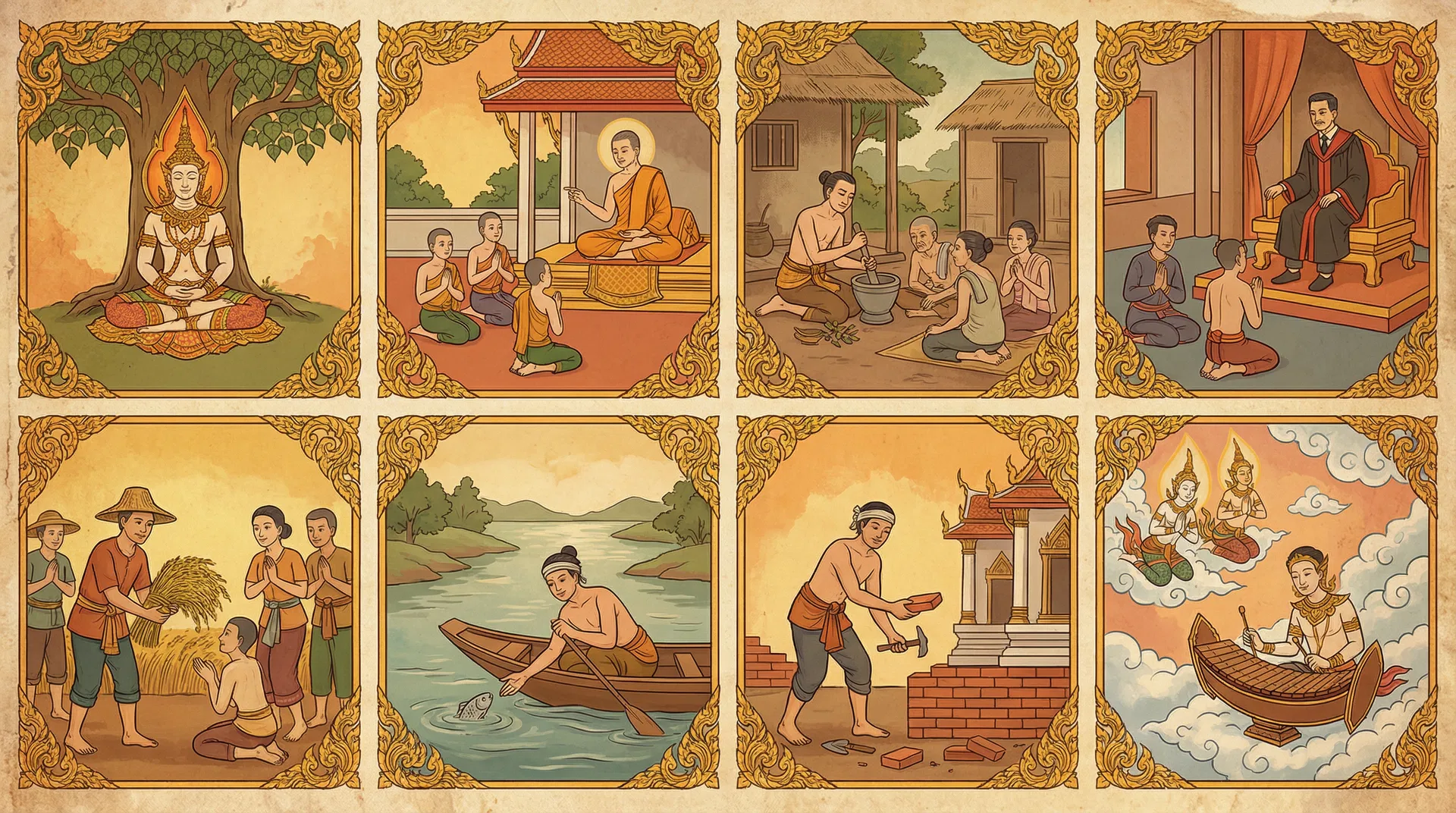
Mugapakkha Jataka
The Tale of the Muzzled Ox
In the ancient city of Mithila, nestled amidst lush gardens and bustling marketplaces, lived a king named Vedeha. King Vedeha was known for his wisdom and his unwavering commitment to justice. However, his reign was not without its challenges. The land, though fertile, was prone to drought, and the people, though industrious, often faced hardship.
One year, the rains failed to arrive. The sun beat down relentlessly, parching the earth and wilting the crops. Despair began to creep into the hearts of the people. King Vedeha, deeply concerned, summoned his wisest advisors. 'My friends,' he declared, his voice heavy with worry, 'our kingdom suffers. What can be done to appease the heavens and bring forth the life-giving rains?'
The advisors, after much deliberation, offered a peculiar suggestion. 'Your Majesty,' the chief advisor said, bowing low, 'ancient texts speak of a ritual. A great sacrifice, involving a specially prepared ox, might appease the celestial beings and restore the balance of nature. This ox must be fed only the finest grains and herbs, and its muzzle must be adorned with jewels. It must be led in solemn procession to the highest hill and offered in prayer.'
King Vedeha, though a kind ruler, was also a pragmatic one. He believed in the power of tradition and the importance of maintaining order. He agreed to the ritual, and the finest ox in the royal stables was chosen. It was a magnificent creature, strong and docile, with eyes that seemed to hold the wisdom of the ages. The royal chefs prepared the most exquisite feed for it, and jewelers crafted a magnificent muzzle, inlaid with glittering rubies, emeralds, and sapphires.
As the day of the ritual approached, a humble ascetic, known for his deep meditation and his profound understanding of the natural world, arrived in Mithila. He was a man of simple means, clad in saffron robes, his hair matted with years of devotion. He observed the preparations for the ox with a growing unease. He saw the fear in the eyes of the people, the desperation that fueled their belief in the ritual.
One evening, as the jeweled muzzle was being fitted onto the ox, the ascetic approached the royal guards. 'Why,' he asked, his voice calm but resonant, 'do you prepare this noble creature for such a fate? Does the sky weep tears of blood when an innocent beast is sacrificed?'
The guards, initially taken aback by the ascetic's presence, replied, 'We are following the king's command, holy one. We believe this sacrifice will bring rain and save our kingdom.'
'But have you considered the true nature of rain?' the ascetic countered. 'Rain is not a gift bestowed by a vengeful god upon a sacrificial offering. Rain is the natural consequence of the earth's cycles, influenced by the purity of the air, the health of the forests, and the actions of all beings. To harm this innocent ox is not an act of piety, but an act of cruelty that will only further imbalance the natural world.'
The guards, though respectful, were bound by duty. The ascetic, seeing their resolve, decided to take a more direct approach. The next morning, as the grand procession began, with the bejeweled ox led by chanting priests, the ascetic stood in the path. He was a solitary figure against the backdrop of the anxious crowd.
'Stop!' he cried, his voice echoing through the square. 'This is not the way! The heavens will not be moved by the shedding of innocent blood. They respond to compassion, to wisdom, and to the harmony of nature!'
King Vedeha, seated on his elephant at the head of the procession, heard the ascetic's words. He had heard of this wise man, and though his advisors had dismissed him, the king felt a strange pull towards his plea. He signaled for the procession to halt.
'Who dares to interrupt this sacred rite?' the king demanded, his voice amplified by the silence that had fallen over the crowd.
'It is I, a humble observer of the natural order,' the ascetic replied, stepping forward. 'Your Majesty, I implore you, do not proceed with this sacrifice. The suffering of this creature will not bring you relief. Instead, let us look to the earth, to the forests that have been neglected, to the rivers that have been polluted, and to the actions that have disrupted the delicate balance of our world.'
The king, intrigued by the ascetic's earnestness, dismounted from his elephant and approached the man. 'What do you propose, then, wise one?'
'Let us not adorn the muzzle of an ox with jewels,' the ascetic said, gesturing towards the magnificent headpiece, 'but let us adorn the minds of our people with wisdom and compassion. Let us plant trees where there are none, restore the rivers, and live in harmony with the land. Let us practice kindness and understanding, not fear and superstition. If we act with true reverence for life, the rains will come, not as a reward, but as a natural unfolding of a healthy world.'
King Vedeha looked at the ox, then at the ascetic, and then at his people, their faces etched with worry. He saw the truth in the ascetic's words. The ritual was born of fear, not of true understanding. He made a bold decision. 'Remove the muzzle,' he commanded. 'Untie the ox. Let this creature live.'
A collective gasp went through the crowd, followed by murmurs of disbelief. But King Vedeha stood firm. He then turned to the ascetic. 'Teach us your ways,' he said. 'Teach us to live in harmony with nature.'
Under the guidance of the ascetic, King Vedeha initiated a new era for Mithila. They stopped the wasteful rituals and instead focused on practical solutions. They organized teams to plant saplings in barren lands, to clear the choked riverbeds, and to educate the people about sustainable practices. The king himself led by example, often seen working alongside his subjects in the fields and forests.
Slowly, subtly, the world around them began to change. The air grew cleaner, the earth seemed to breathe again. And one day, as if by magic, the clouds gathered. Gentle, life-giving rain began to fall upon Mithila. It was not a deluge, but a steady, nurturing shower that brought relief and renewed hope.
The people rejoiced, not because a sacrifice had been made, but because they had learned the true meaning of reverence and responsibility. They understood that the prosperity of their kingdom depended not on appeasing unseen forces, but on their own actions, their own compassion, and their own understanding of the interconnectedness of all life.
King Vedeha, now known as Vedeha the Wise, ruled for many more years, his kingdom flourishing under his enlightened leadership. The tale of the muzzled ox became a legend, a reminder that true salvation comes not from rituals of fear, but from the cultivation of wisdom, compassion, and a deep respect for the natural world.
— In-Article Ad —
💡Moral of the Story
True salvation comes not from superstitious rituals or sacrifices, but from cultivating wisdom, compassion, and living in harmony with the natural world. Our actions, our understanding, and our respect for life are what truly bring about prosperity and balance.
Perfection: Wisdom (Prajna)
— Ad Space (728x90) —
More Jataka Tales You May Enjoy
 533Mahānipāta
Kusa Jātaka
Kusa JātakaIn the ancient kingdom of Kampilla, ruled a just and virtuous king named Okkāka. His reig...
💡 Integrity and truth will always prevail over deceit and envy. True nobility lies not in birthright, but in character, compassion, and the unwavering commitment to justice, even when faced with personal adversity.
 226Dukanipāta
Mūga-pakkhajātaka
The Tale of the Mute Bird In the ancient city of Mithila, nestled amidst lush greenery and shimmerin...
💡 Past actions and their consequences can be overcome through genuine compassion, empathy, and a transformed heart. Understanding and alleviating the suffering of others can lead to the resolution of past karmic debts.
 16Ekanipāta
The Monkey King's Courage
The Monkey King's CourageIn the heart of a verdant jungle, teeming with life and vibrant with the ch...
💡 True courage lies in facing fear and acting for the protection of others, regardless of the odds.
71EkanipātaThe Jataka of the Clenched Fist
In a time long past, in the prosperous city of Varanasi, the Bodhisatta was born as a young Brahmin ...
💡 True leadership lies in protecting the vulnerable, even at great personal risk.
173DukanipātaSīṅgāla Jātaka
Sīṅgāla JātakaIn the bustling city of Varanasi, where merchants hawked their wares and scholars deba...
💡 True understanding comes not just from hearing words, but from observing actions, listening to tone, and discerning the underlying intentions. Honesty and integrity are the foundations of genuine success and respect.
13EkanipātaThe Steadfast Brahmin
The Steadfast BrahminIn the ancient city of Varanasi, a beacon of spiritual learning, lived a devout...
💡 Unwavering steadfastness and a pure heart can inspire others and lead to rebuilding.
— Multiplex Ad —