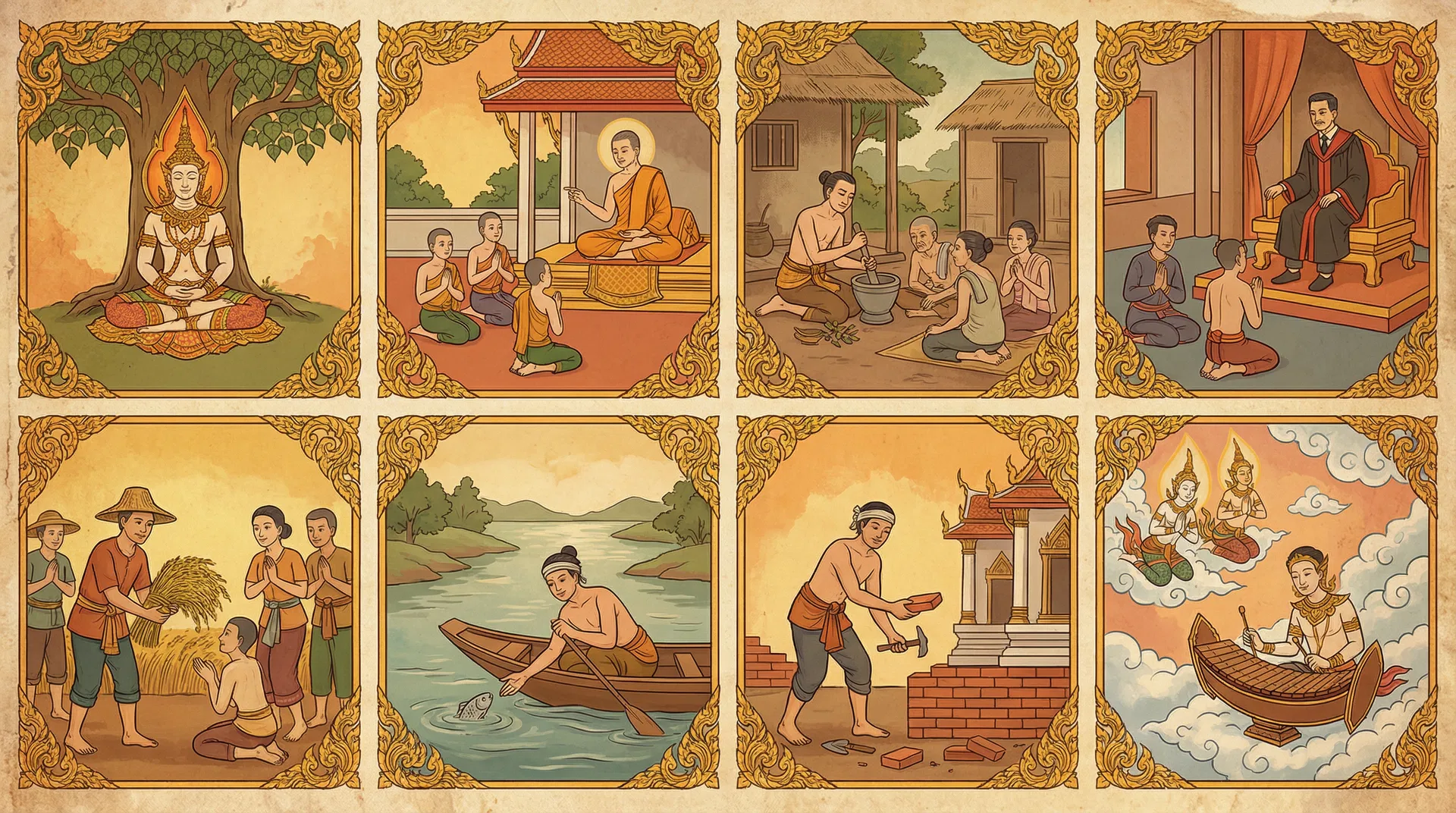
Daddabha Jātaka
Daddabha Jātaka
In the verdant kingdom of Mithila, ruled a king named Brahmadatta, a monarch renowned for his immense generosity. His palace gates were always open, and his coffers were perpetually emptied to feed the hungry, clothe the needy, and shelter the distressed. He believed that the true measure of a ruler was the well-being of his subjects, and his heart overflowed with compassion for all living beings.
Yet, despite his noble intentions and his widespread benevolence, King Brahmadatta was plagued by a peculiar problem: he possessed an uncontrollable temper. When angered, his reason would vanish, and he would lash out with harsh words and impulsive actions, often regretting them deeply once his fury subsided. This volatile temper cast a shadow over his otherwise virtuous reign, causing distress among his courtiers and sometimes leading to ill-advised decisions.
One day, a renowned ascetic, known for his profound understanding of the human mind and his mastery over his own emotions, visited the kingdom. He heard of the king’s generosity and his equally notorious temper. Intrigued, the ascetic sought an audience with the king.
Upon meeting King Brahmadatta, the ascetic bowed respectfully. "Your Majesty," he said, his voice calm and soothing, "I have heard of your boundless generosity, a virtue that shines brightly. However, I also perceive a storm within you, a fire of anger that, if unchecked, could consume even the brightest flame of your benevolence."
The king, taken aback by the ascetic's directness, but also recognizing the truth in his words, sighed. "You speak truly, wise one. My temper is my undoing. I strive to be a king of compassion, but when provoked, my anger overwhelms me, and I say and do things that I later deeply regret. I have tried to control it, but it feels like an untamed beast within me."
The ascetic smiled gently. "Anger, Your Majesty, is like a blazing fire. It can provide warmth and light when controlled, but if allowed to rage unchecked, it destroys everything in its path. The key to mastering it lies not in suppressing it, but in understanding its roots and in cultivating patience and mindfulness."
"But how?" the king implored. "How can I, a king burdened with the affairs of state, possibly tame such a powerful emotion?"
The ascetic proposed a unique method. "From this day forward," he instructed, "whenever you feel the first stirrings of anger, do not speak. Do not act. Instead, immediately take a small, smooth stone from the pouch I shall give you. Hold it tightly in your hand, close your eyes, and focus all your attention on the sensation of the stone. Feel its coolness, its texture, its weight. Breathe deeply, and allow the physical sensation to anchor you. Only when the urge to lash out has completely passed, and you feel a sense of calm returning, should you release the stone and open your eyes."
The king, though skeptical, was desperate for a solution. He accepted the pouch of stones from the ascetic, thanking him profusely. The ascetic then departed, leaving the king to his meditative practice.
The very next day, during a council meeting, one of the king's ministers presented a report that contained a grave error, a mistake that could have had serious repercussions for the kingdom's treasury. Instantly, King Brahmadatta felt the familiar heat rising in his chest. His hands clenched, and his voice began to tremble with fury. But then, he remembered the ascetic's words. He reached into his pouch, pulled out a smooth, grey stone, and closed his eyes, gripping it tightly. He focused on the stone's coolness against his palm, breathing in and out, feeling the solid reality of it grounding him.
The ministers, accustomed to the king’s outbursts, were stunned into silence, watching him with bated breath. The king's face, though initially contorted with rage, slowly began to relax. His breathing deepened, and the tension in his shoulders eased. After what felt like an eternity, he opened his eyes, his gaze now clear and calm. He looked at the minister, not with anger, but with a measured concern. "This error," the king said, his voice steady, "is indeed serious. We must address it immediately. However, let us discuss the best course of action calmly, ensuring we learn from this mistake and prevent its recurrence."
The minister, relieved and grateful, quickly explained the situation, and together they devised a plan to rectify the error. The king's calm demeanor diffused the potentially explosive situation, allowing for a constructive solution.
This practice became the king's daily ritual. Every time anger threatened to consume him – whether it was a minister's incompetence, a courtier's disrespect, or a minor inconvenience – he would reach for his stone. He learned to recognize the physical signs of rising anger and to use the stone as a tangible reminder to pause, breathe, and regain control. The coolness of the stone became a symbol of his growing inner peace.
Over time, the king found that he relied on the stones less and less. The practice had trained his mind. He began to anticipate the onset of anger and to employ the mental techniques the stone had helped him cultivate: deep breathing, mindful observation of his feelings without judgment, and focusing on the present moment. His temper, once a raging inferno, was now a manageable ember, capable of providing warmth without destruction.
His reign transformed. His generosity, now coupled with unwavering composure, became legendary. His subjects rejoiced, finding in their king a pillar of both kindness and stability. The kingdom of Mithila flourished, not just because of its king's benevolence, but because of his newfound mastery over himself. He had learned that true power lay not in commanding others, but in commanding oneself.
— In-Article Ad —
💡Moral of the Story
Mastery over one's emotions, particularly anger, is a sign of true strength and wisdom. By cultivating patience and mindfulness, one can transform destructive impulses into constructive actions.
Perfection: Patience (Khanti) and Truth (Sacca)
— Ad Space (728x90) —
More Jataka Tales You May Enjoy
 25Ekanipāta
The Bodhisatta as a Swan
The Bodhisatta as a SwanIn the shimmering expanse of a celestial lake, where the water was as clear ...
💡 True compassion knows no bounds, and celestial beings are called to act when suffering is present, bringing salvation.
86EkanipātaThe Great Vanga Jataka
Once upon a time, in the glorious city of Savatthi, while the Supreme Buddha resided at Jetavana Mon...
💡 True compassion lies in the willingness to sacrifice one's own well-being for the benefit of others, and such selfless acts can bring about miraculous positive change.
99EkanipātaThe Tale of King Videha
In the prosperous city of Mithila, situated in the thriving kingdom of Videha, renowned for its comm...
💡 True wealth is found in selfless giving and compassion. Generosity, when offered with a pure heart, can bring about miracles and spiritual abundance.
 527Mahānipāta
Mahā-susukajātaka
The Tale of the Contented Monkey In a lush, verdant forest teeming with life, where ancient trees sc...
💡 True happiness and contentment are found not in the abundance of external possessions, but in appreciating what one already has and choosing to find joy in the present moment.
 158Dukanipāta
Kaka Jataka
Kaka JatakaIn the ancient city of Varanasi, nestled beside the sacred river, lived a king renowned f...
💡 True charity requires not only the act of giving but also ensuring the sincerity and purity of the intention and the outcome.
71EkanipātaThe Jataka of the Clenched Fist
In a time long past, in the prosperous city of Varanasi, the Bodhisatta was born as a young Brahmin ...
💡 True leadership lies in protecting the vulnerable, even at great personal risk.
— Multiplex Ad —