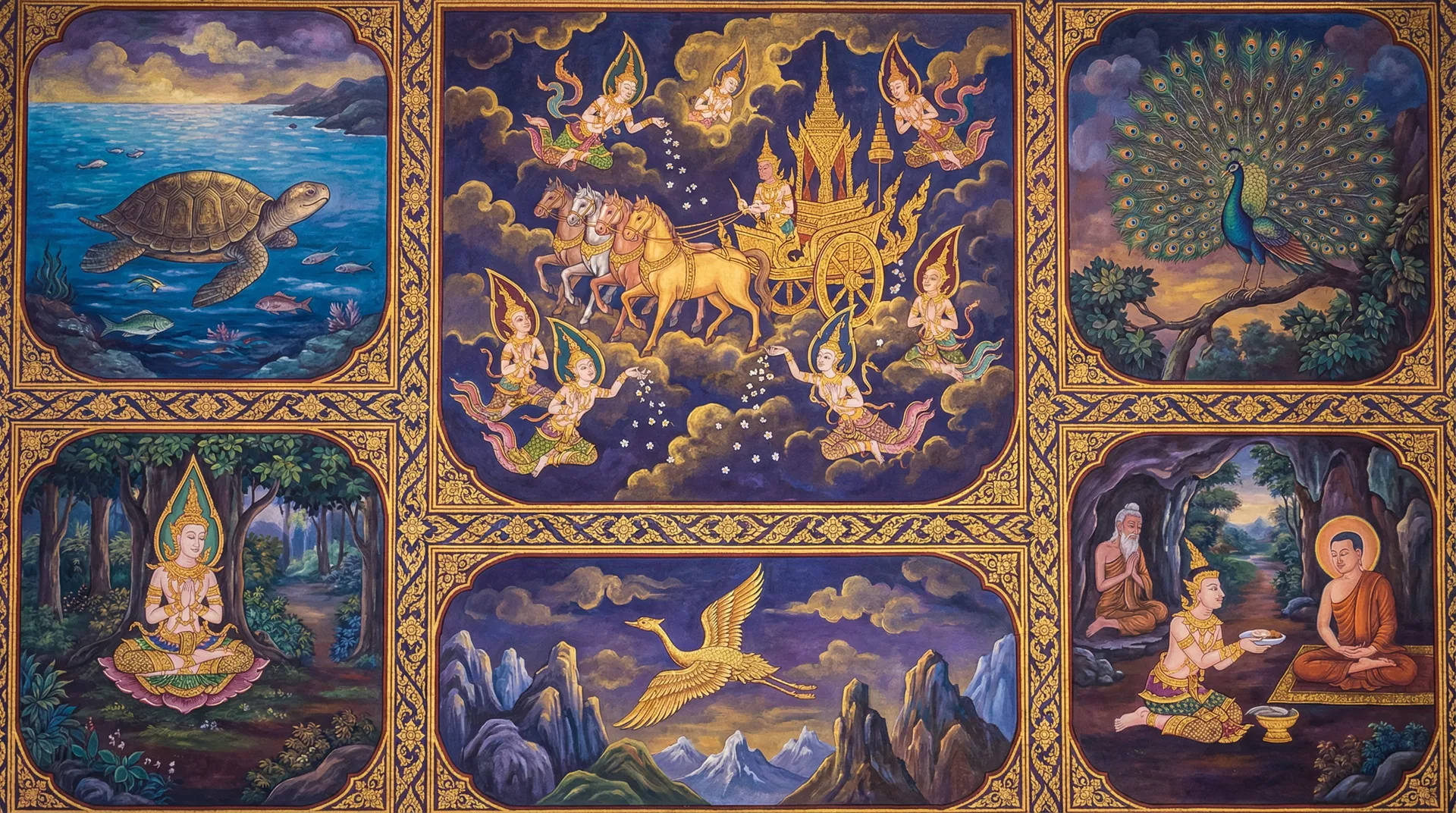
Cattari Puttajataka
Cattari Puttajataka
In the prosperous kingdom of Kasi, ruled a wise and benevolent king named Brahmadatta. The kingdom was known for its fertile lands, its thriving trade, and its contented populace. However, the king faced a peculiar dilemma that tested his understanding of true wealth and the nature of happiness.
One day, the king summoned his chief advisor, a man renowned for his wisdom and his insightful interpretations of the world. "My dear advisor," the king began, his brow furrowed in thought, "I have been contemplating the nature of true prosperity. I have wealth beyond measure, a loving family, and a loyal kingdom. Yet, I feel an emptiness, a sense that there is something more I am missing."
The advisor listened patiently. "Your Majesty, your question touches upon the very essence of life. True wealth is not always measured in gold and jewels. It is often found in qualities that cannot be bought or sold."
The king, intrigued, pressed on. "What are these qualities, then?"
The advisor smiled. "Allow me to tell you a story, Your Majesty, of a man who possessed four sons, each embodying a different aspect of what we might consider 'wealth'."
The advisor then began the tale of a wealthy merchant named Dhanapala. Dhanapala was a man who had amassed a vast fortune through his shrewd business dealings. He lived in a magnificent mansion, surrounded by luxury. He had four sons, each with a distinct personality and approach to life.
The first son, named Ratana, was obsessed with material possessions. He spent his days acquiring the finest silks, the most exquisite jewels, and the grandest chariots. He believed that true happiness lay in owning the most valuable things. Dhanapala, though initially pleased by his son's apparent appreciation for wealth, soon realized that Ratana was never satisfied. No matter how much he acquired, he always craved more, his heart filled with a restless desire.
The second son, named Punya, was devoted to acquiring knowledge and wisdom. He spent his time studying ancient texts, engaging in philosophical debates, and seeking out learned scholars. He believed that true happiness lay in understanding the world and oneself. Dhanapala admired his son's intellect but observed that Punya, while wise, often became detached from the practical realities of life. He could explain the principles of happiness but struggled to experience it fully in his daily interactions.
The third son, named Dhamma, was deeply committed to righteousness and ethical conduct. He dedicated his life to serving others, practicing generosity, and upholding justice. He believed that true happiness lay in living a virtuous life and contributing to the well-being of society. Dhanapala was proud of his son's noble character, but he noticed that Dhamma sometimes became so engrossed in his charitable deeds that he neglected his own needs and well-being, often appearing weary and overburdened.
The fourth son, named Sukha, was the embodiment of contentment and joy. He found happiness in the simple pleasures of life – a warm meal, the company of friends, the beauty of nature, a moment of quiet reflection. He was not driven by a desire for more, nor did he strive for great intellectual pursuits or grand acts of charity. He simply lived in the present moment, appreciating what he had. Dhanapala observed that Sukha radiated a genuine sense of peace and happiness that was infectious, touching everyone he met.
As Dhanapala grew old, he began to reflect on his sons and their different paths. He saw that Ratana, despite his immense wealth, was perpetually unhappy, driven by endless craving. He saw that Punya, with all his wisdom, sometimes missed the simple joys of living. He saw that Dhamma, though virtuous, carried the weight of the world on his shoulders. And he saw that Sukha, with his simple contentment, possessed a profound and effortless happiness.
Dhanapala then understood that while each son represented a valuable aspect, it was Sukha's approach that brought the most genuine and sustainable happiness. He realized that true wealth was not merely the accumulation of possessions, knowledge, or even virtuous deeds, but the inner state of contentment and appreciation for what one has.
The advisor concluded, "Your Majesty, just as Dhanapala learned from his four sons, so too can we learn. The first son represents material wealth, which is fleeting. The second, intellectual wealth, which can be detached. The third, moral wealth, which can be burdensome. But the fourth son, Sukha, embodies the true wealth of contentment. It is this inner peace, this ability to find joy in the present moment and appreciate the blessings we already possess, that is the ultimate source of lasting happiness and true prosperity."
King Brahmadatta meditated on the advisor's words. He realized that his own feeling of emptiness stemmed not from a lack of external possessions, but from an uncultivated inner state. He understood that while striving for knowledge and practicing virtue were important, they should be balanced with an appreciation for the present and a cultivation of inner contentment. From that day forward, King Brahmadatta, inspired by the story of Dhanapala's four sons, began to cultivate contentment in his own heart, finding a deeper and more profound sense of happiness and fulfillment in his life and reign.
— In-Article Ad —
💡Moral of the Story
True and lasting happiness is not found in the endless pursuit of material possessions, intellectual achievements, or even in the heavy burden of constant good deeds, but in the cultivation of inner contentment, appreciating the present moment, and finding joy in life's simple blessings.
Perfection: Contentment (Santutthi Paramita)
— Ad Space (728x90) —
More Jataka Tales You May Enjoy
 251Tikanipāta
Nandiya-Jātaka
Nandiya-JātakaIn the heart of a lush forest, where ancient trees whispered secrets to the wind and s...
💡 True fulfillment and lasting happiness are found not in worldly possessions or power, but in detachment, simplicity, and the pursuit of spiritual enlightenment. The greatest leadership is often demonstrated through selfless sacrifice and the courage to follow one's highest calling.
412SattakanipātaKusa-Jataka
Kusa-JatakaIn the ancient kingdom of Videha, nestled beside the mighty River Ganges, reigned King Ok...
💡 True worth is not measured by wealth or status, but by compassion, wisdom, integrity, and the courage to face challenges with a pure heart. Inner beauty and strength are far more valuable than outward appearances.
 7Ekanipāta
The Steadfast Deer
The Steadfast DeerIn the serene and emerald expanse of a sacred grove, where ancient banyan trees sp...
💡 Unwavering steadfastness and a pure heart can overcome the direst of circumstances.
106EkanipātaBhaddasala Jataka
The Tale of the Wise Elephant and the Foolish King In the ancient kingdom of Mithila, ruled a king n...
💡 True wisdom often comes from unexpected sources. A leader's true strength is shown not in anger or pride, but in humility, compassion, and the willingness to serve their people.
89EkanipātaThe Tale of Añjana the Ascetic
In the ancient city of Benares, during a time long past, the Bodhisatta took birth as the venerable ...
💡 True lasting value is not found in the accumulation of wealth or the display of possessions, but in the merit created through acts of kindness, generosity, and wisdom. Inner virtues are treasures that cannot be lost.
29EkanipātaThe Bodhisatta as a Fish
The Bodhisatta as a FishIn the tranquil depths of a vast and ancient lake, where the water was as cl...
💡 True leadership, guided by wisdom and compassion, inspires courage and unity to overcome daunting challenges.
— Multiplex Ad —