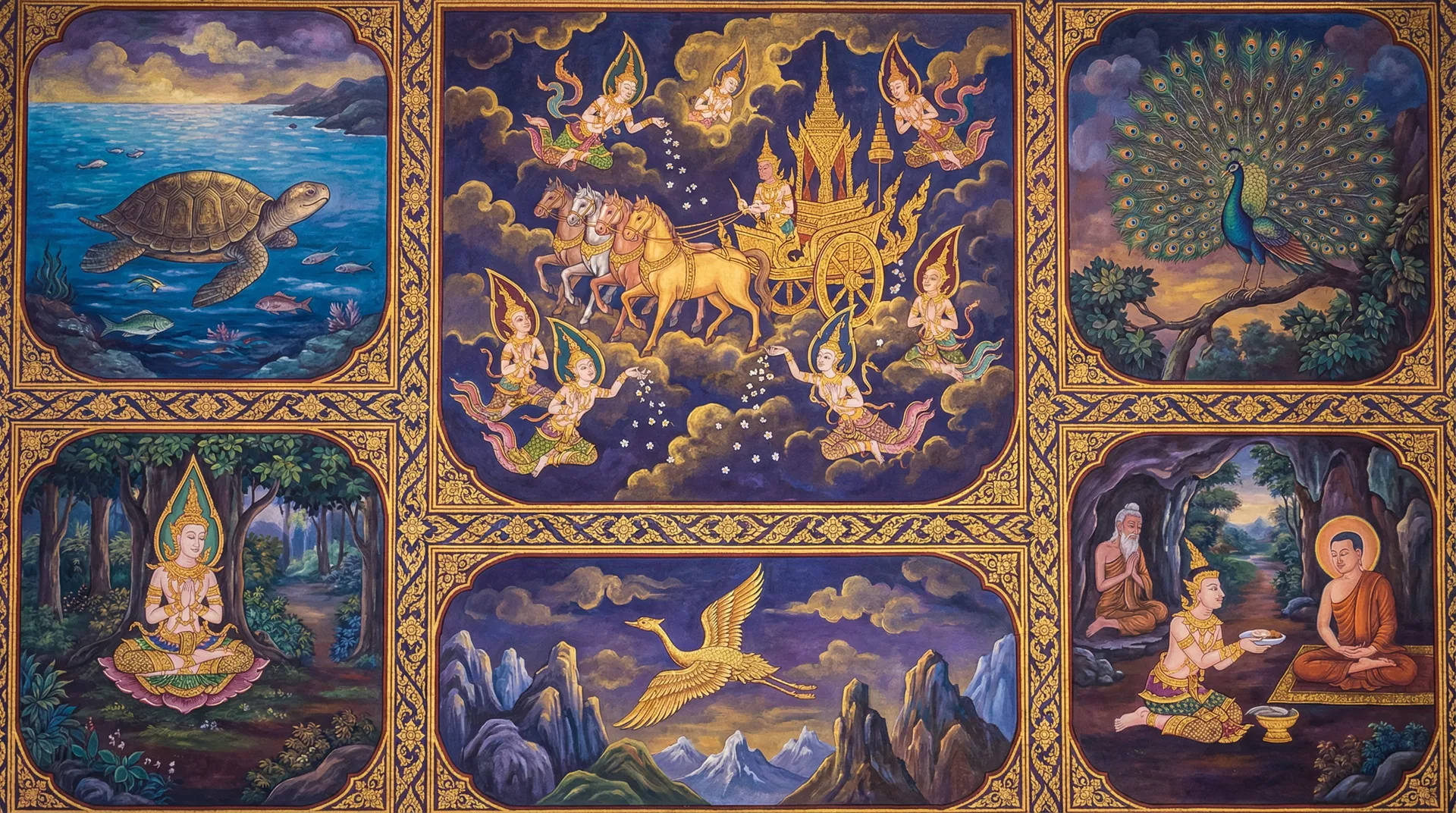
Sutasoma Jataka
Sutasoma Jataka
In the ancient kingdom of Pancala, nestled beside the serene river of Candrabhaga, lived a king named King Supparaka. He was a just ruler, but his reign was overshadowed by a powerful, demonic sorcerer named Kalaka. This sorcerer, with his wicked enchantments and dark magic, terrorized the land, demanding tribute and sowing fear amongst the people. He was particularly fond of consuming human flesh, and his evil deeds cast a long shadow of dread over Pancala.
The Bodhisatta, in this life, was born as Prince Sutasoma, the son of King Supparaka. From a young age, Sutasoma displayed immense courage and a strong sense of justice. He could not bear to see his people suffer under the tyranny of Kalaka.
One day, Kalaka, in his arrogance, sent a message to King Supparaka, demanding that he offer his own son, Prince Sutasoma, as a sacrifice to appease the sorcerer. Kalaka believed that by possessing the prince, he would gain even greater power. King Supparaka was heartbroken, torn between his love for his son and his duty to protect his kingdom from the sorcerer's wrath.
Prince Sutasoma, upon hearing of the sorcerer's demand, did not flinch. Instead, he bravely declared to his father, "Father, do not despair. I will go to Kalaka myself. It is my duty to protect our people. If my life can bring peace to Pancala, then I willingly offer it."
With a heavy heart, King Supparaka gave his blessing. Prince Sutasoma, accompanied by a small retinue, set out towards the dark fortress of Kalaka, situated in a desolate and foreboding region. As he approached, the air grew heavy with dark magic, and the land seemed to wither under its influence.
When Sutasoma arrived, Kalaka, a monstrous figure with eyes like burning coals and a cruel sneer, greeted him. "So, the little prince has come to offer himself!" Kalaka cackled, his voice echoing with malevolence. "You are foolish to come here, boy. You will be my next meal!"
Sutasoma, maintaining his composure, replied, "O Kalaka, I have come as per your demand. But before I become your prey, I wish to understand the source of your power and your cruelty. Tell me, why do you inflict such suffering upon innocent beings?"
Kalaka, amused by the prince's audacity, boasted, "My power comes from the strength of my sorcery and the fear I instill! I take what I want, and no one dares to defy me!"
Sutasoma, seeing the sorcerer's arrogance and his reliance on fear, formulated a plan. He knew that brute force would be useless against such dark magic. He needed to defeat Kalaka with wisdom and a demonstration of true strength – the strength of compassion and self-control.
"Kalaka," Sutasoma said, his voice steady, "you claim to be powerful, yet you are enslaved by your desires and your fear of losing them. I propose a challenge. Let us both demonstrate our strength. You may eat me, but only after I have completed a task. If I succeed, you must release my kingdom from your tyranny and cease your wicked ways. If I fail, you may consume me without restraint."
Kalaka, confident in his victory, readily agreed. "What task could a mere prince perform that I could not? Speak!"
Sutasoma then made his request: "I wish to partake in a feast. Invite all the creatures you have captured and tormented, and let us all share a meal together. If I can make them eat and drink without fear, and if I myself can partake in the feast without showing any aversion, then I shall have completed my task."
Kalaka, intrigued and utterly convinced of the prince's doom, agreed. He summoned all the terrified creatures he had captured – birds, animals, even humans, all trembling in fear. A great feast was prepared, but the atmosphere was thick with dread.
Prince Sutasoma, embodying immense compassion, began to speak to the terrified beings. He spoke of their inherent worth, of the suffering caused by fear, and of the strength that comes from unity and courage. He shared stories of resilience and hope. As he spoke, his own serene demeanor and unwavering courage began to calm their fears. He then sat among them, and with gentle persuasion and a heart full of empathy, he encouraged them to eat. To everyone's astonishment, the creatures, inspired by Sutasoma's fearlessness and his genuine care, began to eat and drink.
Finally, it was Sutasoma's turn to partake in the feast. Kalaka, expecting the prince to recoil from the gruesome offerings, watched with anticipation. However, Sutasoma, with an extraordinary display of self-control and understanding, partook in the feast, showing no sign of disgust or fear. He saw beyond the superficial and understood that all beings are part of the same interconnected web of life.
When Sutasoma had successfully completed his task, he turned to Kalaka. "You see, sorcerer? True strength is not in causing fear or indulging in cruelty, but in compassion, courage, and the ability to overcome one's own base desires. Your power is built on the suffering of others, and it is therefore a fragile power. My strength comes from within, and it is unwavering."
Kalaka, witnessing the prince's incredible feat and his profound inner strength, was humbled. His dark magic seemed to falter in the face of such pure compassion. He realized the emptiness of his own power and the profound wisdom of Prince Sutasoma. He confessed his wickedness and begged for forgiveness.
Prince Sutasoma, embodying boundless compassion, forgave Kalaka. He made the sorcerer promise to renounce his evil ways and use his knowledge for the benefit of others. Kalaka, transformed by the prince's grace, kept his promise. He released all his captives and dedicated himself to helping the people of Pancala.
The kingdom of Pancala rejoiced, freed from the tyranny of the sorcerer. Prince Sutasoma was hailed as a hero, not for his might, but for his extraordinary courage, wisdom, and boundless compassion. He had demonstrated that the greatest victories are often won not on the battlefield, but within the heart, through the power of self-control and empathy.
— In-Article Ad —
💡Moral of the Story
True strength is not found in power over others or in the indulgence of base desires, but in inner fortitude, self-control, compassion, and the courage to face adversity with equanimity. By transforming one's own heart and extending kindness, one can overcome even the darkest of forces.
Perfection: Self-Control (Indriya Samvara Paramita), Compassion (Karuna Paramita)
— Ad Space (728x90) —
More Jataka Tales You May Enjoy
 422Aṭṭhakanipāta
Sammodamāna Jātaka
Sammodamāna JātakaIn the ancient city of Varanasi, nestled beside the sacred Ganges River, lived a w...
💡 Unity, open communication, and mutual respect are the cornerstones of lasting success and true prosperity. Harmony achieved through collaboration is far more powerful than individual cunning or division.
 236Dukanipāta
Mugapakkha Jataka
Mugapakkha JatakaIn the ancient kingdom of Mithila, nestled beside the shimmering Gandaki River, liv...
💡 True wisdom and effective communication can manifest in many forms, not just through speech. Inner silence can cultivate profound understanding and strength.
 78Ekanipāta
The Jataka Tale of the Lion's Wisdom
The Jataka Tale of the Lion's Wisdom In the ancient city of Varanasi, a place renowned for its gran...
💡 Intelligence, the ability to see opportunities, and the courage to face risks can lead to wealth and benefit society.
25EkanipātaThe Bodhisatta as a Swan
The Bodhisatta as a SwanIn the shimmering expanse of a celestial lake, where the water was as clear ...
💡 True compassion knows no bounds, and celestial beings are called to act when suffering is present, bringing salvation.
41EkanipātaThe Tale of the Clever Crow
The Tale of the Clever Crow In the ancient city of Varanasi, nestled beside the sacred River Ganges...
💡 Disobedience to the teachings of experienced and benevolent individuals leads to suffering and destruction. Leaders must possess patience, sacrifice, and guide people towards the right path.
109EkanipātaSutasoma Jataka
The Tale of the Compassionate Prince and the Hungry Ogress In the grand kingdom of Gandhara, renowne...
💡 True compassion understands and alleviates suffering, even in the face of fear. Selfless kindness can transform even the most hardened hearts.
— Multiplex Ad —