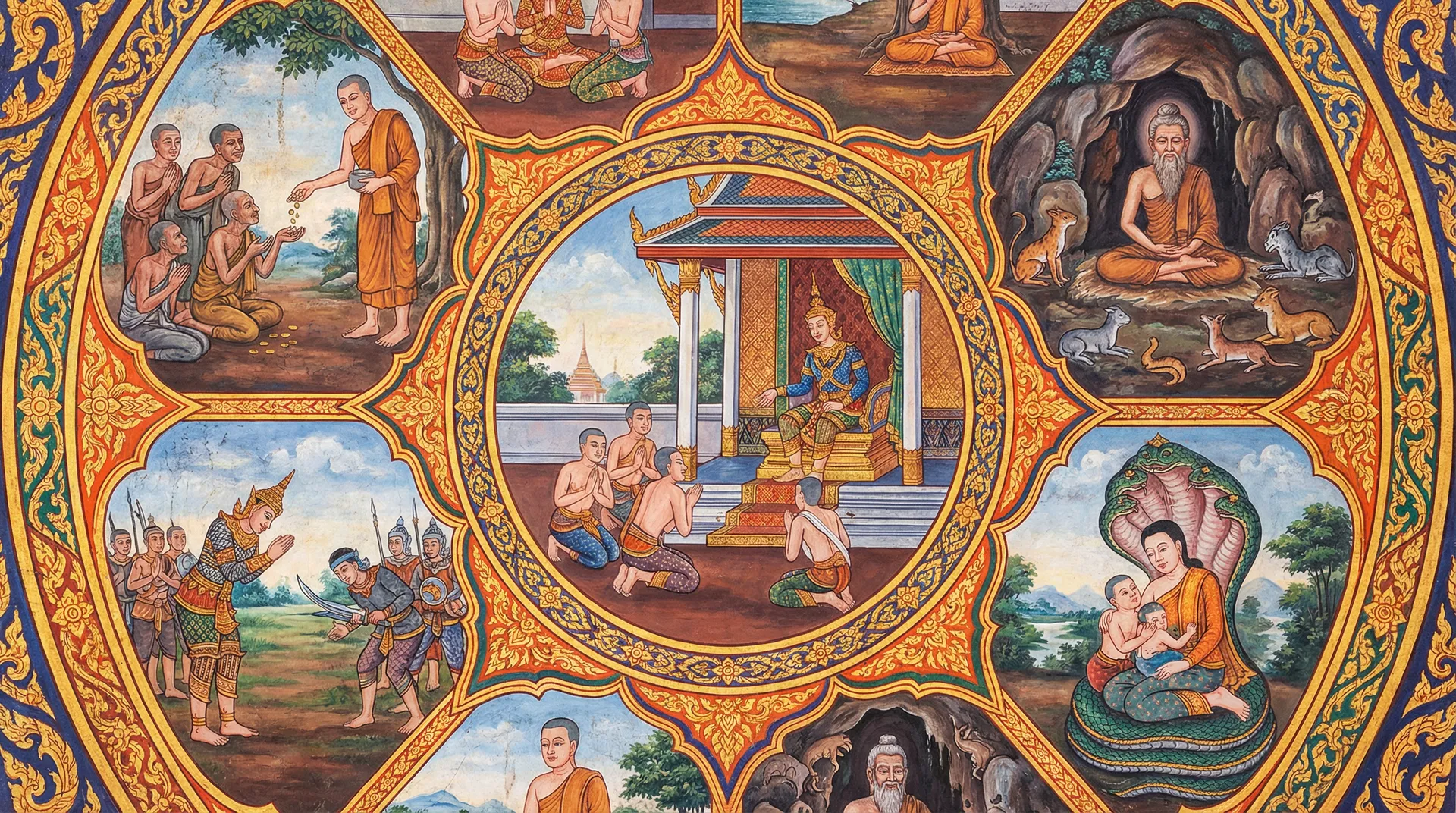
SAMUDDAPALA JATAKA
SAMUDDAPALA JATAKA
In the ancient city of Varanasi, where the Ganges flowed like a silver ribbon, lived a Bodhisattva of unparalleled compassion. In this particular lifetime, he was born as a young prince named Samuddapala, heir to the throne of the kingdom. Prince Samuddapala was not like other princes. While his peers reveled in martial pursuits and courtly pleasures, Samuddapala was drawn to the quiet contemplation of the Dharma. He spent his days studying ancient texts, meditating in serene gardens, and offering solace to those in need. His heart overflowed with a desire to alleviate the suffering of all sentient beings.
One day, a great famine struck the land. The crops withered, the rivers dwindled, and the people, once prosperous, faced starvation. The king, Samuddapala's father, was a good man but powerless against the wrath of nature. He had exhausted the royal granaries and levied heavy taxes, but it was not enough. Despair settled over the kingdom like a shroud.
Prince Samuddapala, witnessing the suffering of his people, felt a profound ache in his heart. He could not bear to see them perish. He approached his father, his eyes filled with resolve. "Father," he said, his voice clear and steady, "I have a proposal that may save our people. I will offer myself as a servant to the king of the neighboring kingdom of Gandhara. Their king is known for his immense wealth and his insatiable desire for rare and precious things. If he desires a prince, I shall give myself to him, and in return, I will ask for a vast store of grain to feed our starving people."
The king was aghast. "My son!" he exclaimed. "How can you speak of such a thing? Your life is precious! I cannot allow you to sacrifice yourself!"
But Samuddapala was resolute. "Father," he replied, "what is my life compared to the lives of thousands of our subjects? True royalty lies not in preserving one's own life, but in sacrificing it for the welfare of the people. If my offering can bring sustenance and hope, then my life is well spent." He continued to plead, explaining his conviction that such a sacrifice would not only save their kingdom but also sow seeds of great merit for himself.
Seeing his son's unwavering determination and the depth of his compassion, the king, with a heavy heart, finally relented. He understood that his son's wish was not born of recklessness, but of a profound and selfless love for his people. Preparations were made, and Prince Samuddapala, clad in simple robes, set out for the kingdom of Gandhara, accompanied by a small retinue. He carried with him a letter from his father, detailing the dire situation and offering his son as a tribute.
Upon arriving at the opulent court of Gandhara, Prince Samuddapala was presented to King Ajatasatru, a ruler known for his avarice and his love of exotic acquisitions. King Ajatasatru, a portly man with beady eyes, surveyed the young prince with a greedy glint. He had heard tales of Varanasi's beauty, but he had never imagined its prince would be offered to him.
"So," King Ajatasatru boomed, his voice laced with triumph, "you are the prince who is to be my servant?"
Prince Samuddapala bowed respectfully. "Indeed, Your Majesty. I am Prince Samuddapala, and I am here to offer myself in your service. In return for your acceptance of me as your humble servant, I beg you to grant a boon to my kingdom: a vast supply of grain to save my people from starvation."
King Ajatasatru, amused by the prince's earnestness and tempted by the prospect of possessing a royal captive, readily agreed. He saw Samuddapala not as a person, but as another valuable commodity. The prince was given quarters within the palace, treated more like a prized possession than a guest. He was fed adequately, but his days were filled with servitude, performing menial tasks and enduring the king's capricious demands.
Yet, even in his servitude, Prince Samuddapala's spirit remained unbroken. He found opportunities to teach the palace staff about kindness and compassion. He shared his meager meals with the palace servants, who were often treated harshly. He offered words of comfort to those who were downtrodden. His inherent goodness began to subtly influence those around him.
Meanwhile, back in Varanasi, the grain arrived in a seemingly endless procession of carts. The people rejoiced, their hunger abated, and their hope rekindled. The king, though relieved, could not shake off the sorrow of his son's absence. He often looked at the granaries, filled with the bounty that had cost him his heir.
One day, King Ajatasatru, in a fit of pique, ordered Prince Samuddapala to perform a particularly arduous and humiliating task. He was to carry a heavy sack of grain up a steep mountain path, a task meant to break his spirit. As Samuddapala toiled, a group of ascetics, drawn by the prince's aura of kindness, watched from afar. They saw his suffering, but also his unwavering resolve and the purity of his intention.
One of the ascetics, a wise old hermit, approached the prince. "Young man," he said gently, "why do you endure such hardship?"
Samuddapala, though weary, explained his sacrifice. The hermit, deeply moved by the prince's compassion, recognized the immense merit being generated by his selfless act. The hermit then revealed himself to be a celestial being, who had been observing the prince's virtue. "Your sacrifice," the celestial being declared, "is a testament to the highest form of compassion. The merit you are generating is immeasurable. I shall ensure that your people are forever protected from famine."
With a wave of his hand, the celestial being caused the mountain path to shimmer. Suddenly, the heavy sack of grain felt light as a feather. When Samuddapala reached the summit, he found not just the grain, but a magical seed that, when planted, would yield crops that were resistant to drought and blight, ensuring perpetual abundance for Varanasi.
King Ajatasatru, hearing of this miraculous event, was filled with awe and a touch of fear. He realized that he had underestimated the prince and the power of his virtue. He began to treat Samuddapala with a newfound respect. The prince, seeing the shift in the king's demeanor, saw an opportunity. He spoke to King Ajatasatru about the importance of compassion and the true meaning of wealth, which lies not in possessions but in the well-being of one's people.
King Ajatasatru, humbled by the prince's wisdom and the celestial intervention, underwent a profound change. He became a just and benevolent ruler, inspired by Samuddapala's example. Eventually, the prince was allowed to return to his kingdom, not as a servant, but as a respected figure. He returned to Varanasi, not just with the promise of food, but with a deeper understanding of the world and the power of selfless love.
Prince Samuddapala, upon his return, helped his father establish agricultural practices that ensured the kingdom's prosperity for generations to come. He never forgot his time in Gandhara, nor the suffering he had witnessed. He dedicated his life to serving his people, embodying the true meaning of kingship – the unwavering commitment to the welfare of all.
— In-Article Ad —
💡Moral of the Story
True leadership lies in selfless sacrifice for the well-being of the people. Compassion and virtue have the power to transform even the most avaricious hearts and bring about lasting prosperity.
Perfection: Generosity
— Ad Space (728x90) —
More Jataka Tales You May Enjoy
 23Ekanipāta
The Bodhisatta as a King of Birds
The Bodhisatta as a King of BirdsIn the celestial realm of the heavens, where clouds of spun gold dr...
💡 True wisdom lies in selfless compassion, and the greatest sacrifices bring about miraculous salvation.
35EkanipātaThe Bodhisatta as the Wise Prince Kumara
The Bodhisatta as the Wise Prince Kumara In the ancient kingdom of Mithila, nestled amidst verdant ...
💡 Greed and evil thoughts erode virtue and goodness, like poison destroying the fragrance of the Kandapala tree. Deceiving others leads to ruin.
36EkanipātaThe Tale of the Horse-Breeder
In a past aeon, in the flourishing city of Varanasi, the Bodhisatta was born as a young Brahmin, end...
💡 The highest form of virtue is selfless compassion, willing to sacrifice for the well-being of others.
 236Dukanipāta
Mugapakkha Jataka
Mugapakkha JatakaIn the ancient kingdom of Mithila, nestled beside the shimmering Gandaki River, liv...
💡 True wisdom and effective communication can manifest in many forms, not just through speech. Inner silence can cultivate profound understanding and strength.
93EkanipātaAssaka Jataka
Assaka JatakaIn the ancient kingdom of Kasi, nestled beside the gentle flow of the River Ganges, sto...
💡 True generosity requires discernment. One must be careful not to be deceived by outward appearances or false piety, ensuring that one's charitable acts benefit those who are genuinely in need.
86EkanipātaThe Great Vanga Jataka
Once upon a time, in the glorious city of Savatthi, while the Supreme Buddha resided at Jetavana Mon...
💡 True compassion lies in the willingness to sacrifice one's own well-being for the benefit of others, and such selfless acts can bring about miraculous positive change.
— Multiplex Ad —