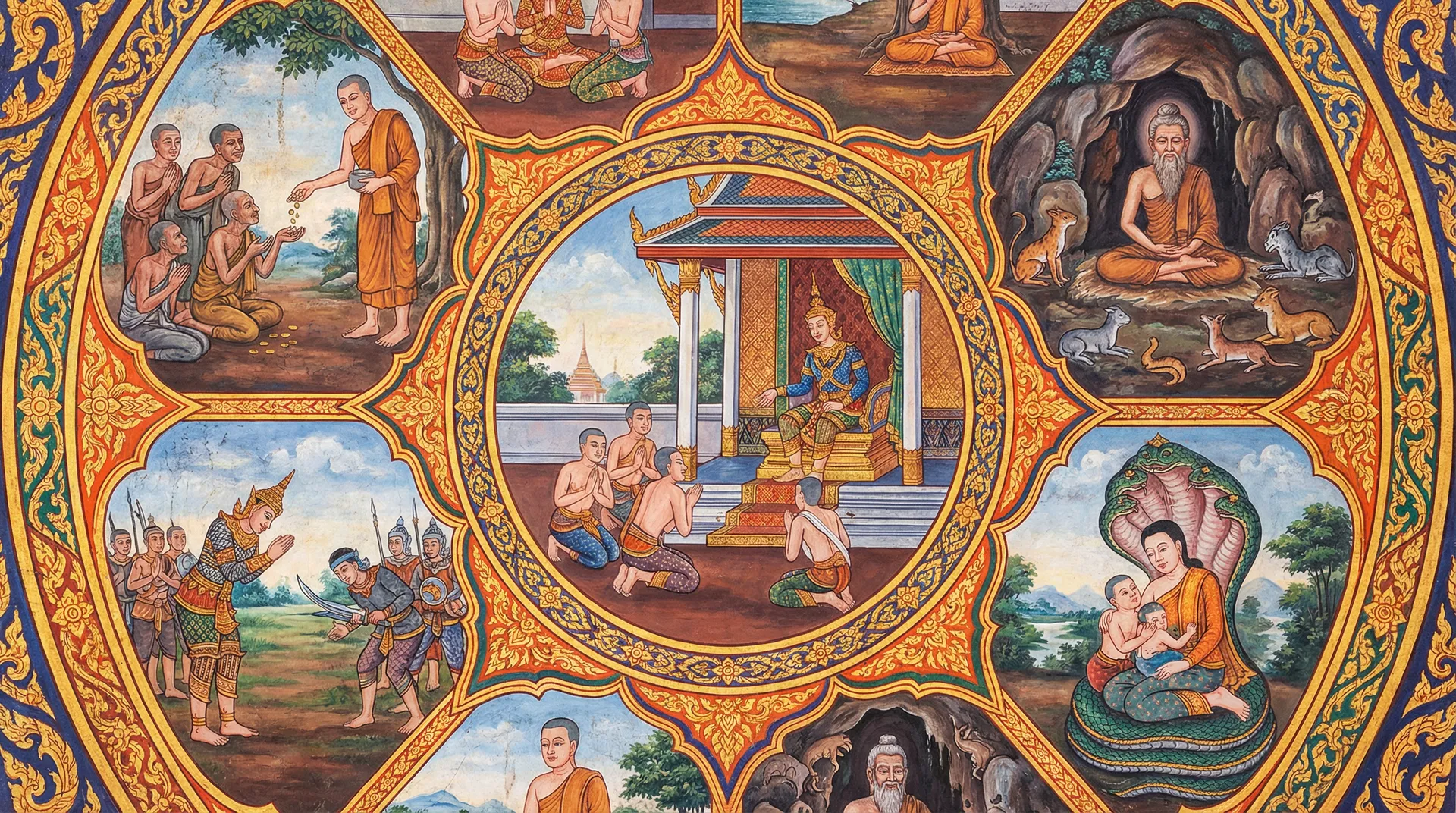
Sutasoma Jataka
Sutasoma Jataka
In the ancient kingdom of Kampilya, known for its chivalrous knights and its strong defense, lived a Bodhisatta destined for greatness. In this lifetime, he was born as Prince Sutasoma, the son of King Pāṇḍava. Prince Sutasoma was not only endowed with royal grace and strength but also possessed a profound sense of justice and an unwavering commitment to truth. He trained rigorously in the arts of warfare and governance, preparing himself to one day lead his kingdom with wisdom and righteousness.
However, destiny had a more challenging path in store for him. In the same land resided a powerful and fearsome Rakshasa (demon) named Kaḷakañjā. This Rakshasa was a creature of immense strength and insatiable hunger, notorious for preying on humans, particularly kings and princes, whom he devoured to enhance his own power. He had grown arrogant with his victories, believing himself invincible.
One day, Kaḷakañjā, driven by his cruel ambition, challenged King Pāṇḍava. The king, though brave, was no match for the Rakshasa's demonic might. In a tragic turn of events, King Pāṇḍava was slain and devoured by Kaḷakañjā. The kingdom was plunged into despair, and the people feared for their lives, knowing that the Rakshasa would soon turn his attention to the young prince.
Prince Sutasoma, though grief-stricken by the loss of his father, did not succumb to despair. Instead, he channeled his sorrow into a fierce resolve. He knew that to avenge his father and protect his people, he had to confront the Rakshasa. However, he also understood the Rakshasa's immense power and the futility of a direct, brute-force assault.
The Bodhisatta, in his wisdom, devised a plan. He decided to engage Kaḷakañjā not in a battle of strength, but in a battle of wits and resolve. He knew the Rakshasa’s weakness: his pride and his insatiable desire for power, which he believed he gained through consuming noble beings.
Prince Sutasoma approached the Rakshasa's lair, a dark and forbidding cave deep within the mountains. He announced his presence, not with a challenge of arms, but with a proposition. “Great Kaḷakañjā,” he called out, his voice echoing through the desolate landscape, “I am Prince Sutasoma. I have come not to fight you with swords, but to offer myself to you. I wish to be devoured by you, so that I may perhaps impart some strength and nobility to your being, and in turn, understand the true nature of your power.”
The Rakshasa emerged from his cave, his eyes burning with malevolent glee. He had expected a terrified prince begging for mercy or a foolish warrior seeking a futile death. This offer was far more intriguing, and more importantly, it fed his immense ego. “You offer yourself, little prince?” Kaḷakañjā sneered, his voice like grinding stones. “Do you truly believe your flesh holds any power over me? I have devoured kings and heroes! What makes you so special?”
“My strength lies not in my flesh, but in my truth,” Sutasoma replied calmly. “I am a prince sworn to uphold justice and righteousness. If you consume me, perhaps some of that essence will enter you. And if you do consume me, I ask for a boon.”
The Rakshasa, intrigued by the prince’s courage and the potential for a rare feast, agreed. “Speak your boon, prince. But know that I am not known for my generosity.”
“My boon is simple,” said Sutasoma. “If you devour me, you must promise not to harm any other human being for seven days thereafter. Allow me this final act of service to my people.”
Kaḷakañjā, blinded by his arrogance and the prospect of consuming a prince, readily agreed. He saw no threat in this promise; seven days were but a moment to him. He lunged at Prince Sutasoma, and with a terrifying roar, he devoured the prince whole.
Inside the Rakshasa’s cavernous belly, Prince Sutasoma, instead of despairing, began his work. He knew that the Rakshasa’s power was derived from the fear and suffering he inflicted. Sutasoma decided to confront the Rakshasa from within, not with physical force, but with the power of truth and unwavering resolve.
He began to speak, his voice resonating powerfully within the Rakshasa’s insides. “Kaḷakañjā! You have consumed me, but you have not consumed my truth. Your strength comes from fear, but I am not afraid. You feast on suffering, but I offer compassion. Release me, and I promise you a path beyond this endless hunger.”
The Rakshasa writhed in agony. The prince’s words, imbued with the Bodhisatta’s spiritual power, were like burning coals within him. He felt a profound discomfort, a spiritual sickness that his demonic nature could not comprehend. His power seemed to wane, and his arrogance began to crack.
“Who are you?” the Rakshasa roared, his voice laced with fear. “What magic is this?”
“I am Sutasoma,” the prince replied, his voice unwavering. “And I offer you not destruction, but liberation. Your hunger is a curse born of hatred and violence. Embrace truth, and find peace.”
The Rakshasa, tormented by the prince’s words and the strange weakness spreading through him, could bear it no longer. He roared in anguish and, with a tremendous effort, vomited Prince Sutasoma out of his body. The prince emerged, unharmed, his robes slightly soiled but his spirit radiant.
The Rakshasa, utterly defeated not by weapons but by the power of truth and unwavering courage, fell to his knees. He had never encountered such a being. The prince’s words had pierced his demonic heart, showing him the emptiness of his existence.
“Prince Sutasoma,” the Rakshasa stammered, his voice humbled, “I have been a slave to my hunger and my rage for eons. You have shown me a different path. I cannot devour you, for your spirit is too strong. I release you, and I vow to cease my predatory ways. I will seek a different way to sustain myself, one that does not involve harming others.”
Prince Sutasoma, seeing the genuine remorse in the Rakshasa’s eyes, granted him forgiveness. He did not seek vengeance but offered compassion. He left the Rakshasa to contemplate his newfound understanding, knowing that the seed of truth had been planted.
Prince Sutasoma returned to his kingdom, not as a vengeful warrior, but as a wise leader who had faced darkness with light. He had proven that courage is not merely the absence of fear, but the mastery of it, and that truth and compassion possess a power far greater than any physical force. His act of self-sacrifice and his unwavering adherence to truth had not only saved his life but had also begun the transformation of a monstrous being, demonstrating the profound impact of unwavering moral conviction.
— In-Article Ad —
💡Moral of the Story
Unwavering truth, courage, and compassion possess a power that can overcome even the greatest evil and transform the hearts of those who inflict suffering. True strength lies in moral conviction, not brute force.
Perfection: Truthfulness (Sacca Paramita), Courage (Virya Paramita), Compassion (Karuna Paramita)
— Ad Space (728x90) —
More Jataka Tales You May Enjoy
 284Tikanipāta
Mahāpaduma Jātaka
Mahāpaduma JātakaIn the heart of a lush forest, far from the clamor of human settlements, lived a Bo...
💡 True beauty and value lie within the heart, not in external possessions or trophies. Greed and cruelty ultimately lead to sorrow and regret.
283TikanipātaSādhina Jātaka
Sādhina JātakaIn the sun-drenched kingdom of Kalinga, ruled a king named Sādhina, whose reign was ma...
💡 True wealth is not measured by material possessions, but by the well-being of one's people and the purity of one's heart. Greed leads to suffering and the decline of prosperity.
282TikanipātaSutasoma Jātaka
Sutasoma JātakaLong ago, in the land of Kasi, there lived a wise and virtuous king named Sutasoma. H...
💡 True strength lies in compassion, forgiveness, and selflessness. Kindness can conquer even the most hardened hearts.
 530Mahānipāta
Samyuttakapālajātaka
The Tale of the Broken Pot In the heart of a vibrant city, known for its skilled artisans and bustli...
💡 Anger can be destructive, preventing us from seeing new possibilities. When faced with setbacks and brokenness, it is important to manage our anger, adapt, and look for new ways to create and find beauty.
 405Sattakanipāta
Vidhurapandita Jataka
Vidhurapandita JatakaIn the bustling city of Indapatta, capital of the kingdom of Kuru, ruled King D...
💡 Integrity, wisdom, and adherence to truth are the greatest shields against danger and deception, and ultimately lead to liberation and respect.
363PañcakanipātaKaccābu Jātaka
Kaccābu JātakaIn the ancient kingdom of Mithila, ruled by a benevolent king, there lived a Bodhisatt...
💡 Physical ailments are often a reflection of inner mental and emotional imbalances. Cultivating a calm, compassionate, and virtuous mind is essential for true healing and well-being, as it addresses the root causes of suffering rather than just its symptoms.
— Multiplex Ad —