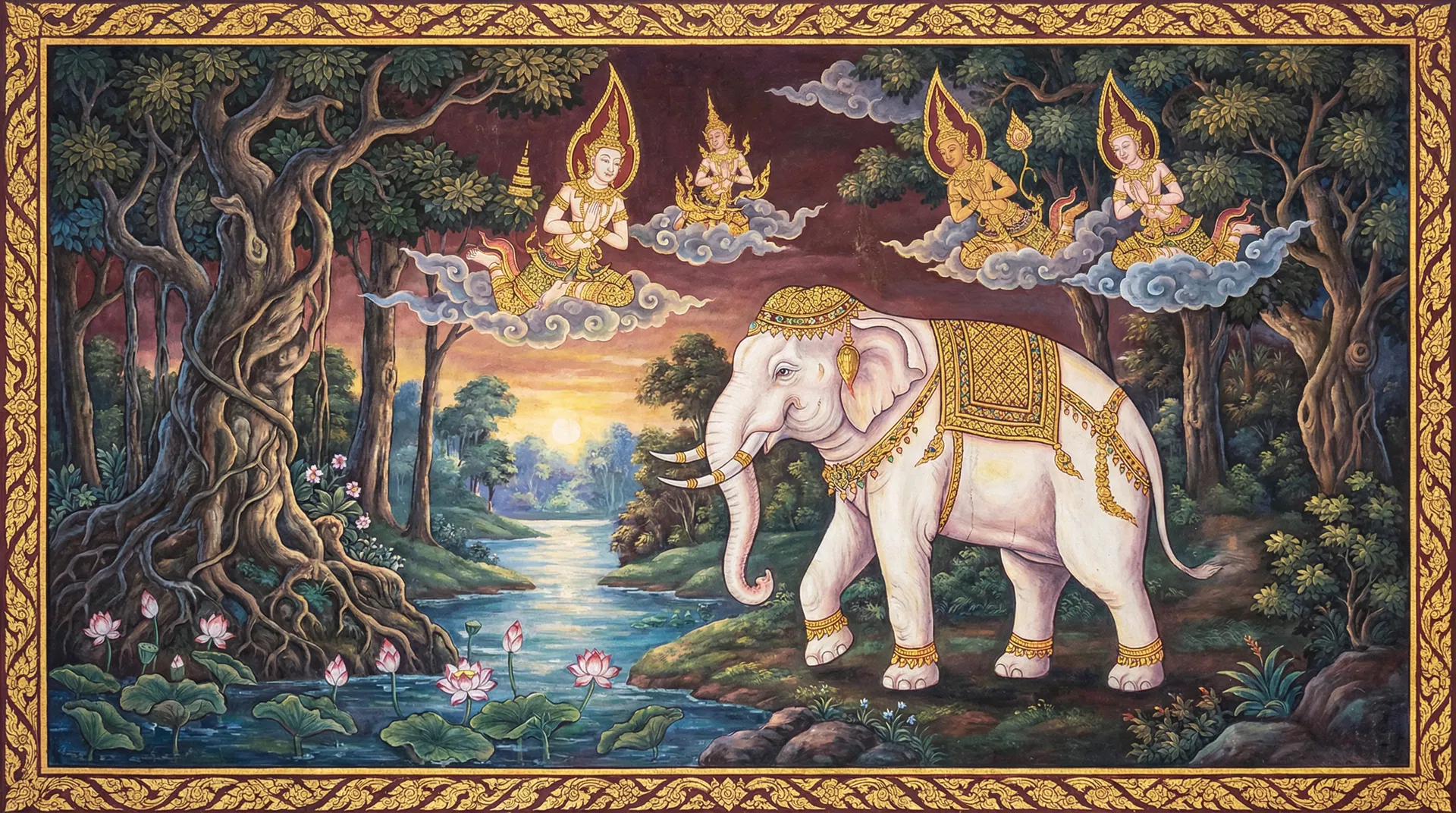
Suvaṇṇamriga Jātaka
The Golden Deer Jātaka
In a kingdom blessed with abundant forests and sparkling rivers, there lived a prince named Sutasoma. He was known for his righteousness, his courage, and his unwavering adherence to the Dharma. The people loved him, and his father, the king, saw in him the perfect heir to his throne.
One day, while hunting in the deep woods, Prince Sutasoma encountered a creature unlike any he had ever seen. It was a deer, but its coat was not the usual dappled brown. Instead, it shimmered with the radiant glow of pure gold, its antlers like polished ivory tipped with emeralds. Its eyes were like two pools of liquid sapphire, reflecting a gentle and profound wisdom. This was no ordinary deer; it was the Bodhisatta, living his life as a noble creature of the forest.
The sight of the golden deer was so breathtaking that the prince, for a moment, forgot his hunter's instinct. He stood mesmerized by its ethereal beauty. But then, the allure of possessing such a magnificent prize seized him. He thought of the fame and glory he would gain by presenting this unique creature to his father.
"Halt, noble deer!" the prince called out, his voice echoing through the silent trees. "You are a wonder of nature, and I wish to claim you as a royal trophy."
The golden deer looked at the prince with an expression of calm sorrow. Then, to the prince's astonishment, it spoke in a clear, resonant voice. "O Prince Sutasoma, I am not merely a creature to be hunted. I am a being of wisdom and compassion, and I have taken this form to observe the world and to practice the virtues of patience and non-violence. If you capture me, you will bring only suffering to yourself and to this forest."
The prince was stunned. A talking deer was extraordinary, but a deer that spoke of wisdom and compassion was something else entirely. He hesitated, his hand still on the reins of his horse. "But... you are so beautiful. Such a creature should be known, admired by all."
The golden deer sighed, a sound like the rustling of autumn leaves. "Beauty, Prince, is not meant to be possessed, but to be appreciated. True admiration comes from understanding, not ownership. If you wish to admire me, then let me roam free. I will allow you to witness my beauty, to hear my wisdom, but I will not be your captive."
The Bodhisatta then made a solemn promise: he would remain within the boundaries of the forest, and he would reveal himself to the prince at dawn each day, allowing the prince to witness his golden splendor from afar. In return, the prince must vow never to harm him or any creature in the forest, and to rule his kingdom with justice and compassion.
Prince Sutasoma, deeply moved by the deer's words and its profound offer, felt a profound sense of shame for his earlier intentions. He saw the wisdom in the deer's plea and the noble spirit behind its golden form. He lowered his bow and knelt before the creature. "I accept your terms, noble deer. I vow to protect you and all beings in this forest, and I shall strive to rule my kingdom with the same compassion you have shown me."
From that day on, Prince Sutasoma visited the forest each morning. He would sit at the edge of the clearing and watch the golden deer emerge, its magnificent form bathed in the rising sun. He listened intently as the deer shared its profound insights on life, truth, and the nature of suffering. The deer's teachings were like a balm to his soul, shaping his understanding and reinforcing his commitment to righteous rule.
As Sutasoma grew older, he ruled his kingdom with exemplary justice. He was merciful to the wrongdoers, generous to the needy, and always sought to uphold the Dharma. The kingdom prospered under his reign, and his people lived in peace and harmony. He never forgot the golden deer, his silent mentor, whose luminous presence and wise counsel had guided him towards a life of virtue.
One day, however, a jealous courtier, envious of the prince's popularity and the kingdom's prosperity, spread a rumor that the prince was wasting his time communing with a mere animal, neglecting his royal duties. He incited a mob, driven by suspicion and fear, to hunt down the golden deer, believing it to be a source of dark magic or a dangerous illusion.
When Prince Sutasoma heard of this, his heart sank. He rushed to the forest, but it was too late. The mob, armed with spears and torches, had cornered the golden deer. The Bodhisatta, true to his promise, did not flee. He stood calmly, awaiting his fate.
Prince Sutasoma, seeing the danger, threw himself between the mob and the deer. "Stop!" he cried, his voice ringing with authority and anguish. "This creature is under my protection! It is a being of great virtue, and to harm it is to harm the very essence of justice!"
The mob, blinded by their prejudice, did not listen. In their fervor, one of them hurled a spear, which struck the golden deer. As the spear pierced its side, the deer did not cry out in pain. Instead, its golden radiance intensified for a moment, and then it vanished, leaving behind only a single, radiant tear that fell onto a patch of dry earth.
Prince Sutasoma, heartbroken, picked up the tear. As he held it, he felt a surge of renewed determination. He confronted the mob, not with anger, but with the sorrowful weight of their ignorance. He explained the true nature of the golden deer, the wisdom it had shared, and the virtue it embodied. He reminded them of his own righteous rule, inspired by the deer, and the peace they had all enjoyed.
Though the golden deer was gone, its teachings remained etched in the prince's heart. He continued to rule his kingdom with even greater dedication, always remembering the sacrifice of the golden deer and the importance of seeing beyond superficial appearances to the true nature of beings. The single tear, planted by the prince, miraculously grew into a magnificent golden lotus, a symbol of the enduring power of virtue and compassion, forever reminding the kingdom of the lessons learned from the luminous, golden deer.
— In-Article Ad —
💡Moral of the Story
True beauty and wisdom are to be appreciated and understood, not possessed. Righteous rule and compassion are cultivated through learning from virtuous beings, even if they appear in humble forms.
Perfection: Generosity (Dāna Pāramī)
— Ad Space (728x90) —
More Jataka Tales You May Enjoy
 294Tikanipāta
Sambhava Jātaka
The Tale of the Bodhisatta's ReturnIn the verdant kingdom of Sāketā, a wise and just king named Mahā...
💡 True renunciation is not about escaping one's responsibilities, but about fulfilling them with detachment and using one's position to benefit others. The legacy of a virtuous life is seen in the actions of those who follow.
 223Dukanipāta
Cullapada Jataka
Cullapada JatakaIn the bustling city of Mithila, a jewel of the eastern lands, ruled King Janaka, a ...
💡 Honesty and integrity, even regarding minor flaws or imperfections, build trust and are more valuable than a superficial claim of perfection. True worth is found in acknowledging reality.
234DukanipātaPhra Ong Thammachak (The Bodhisatta as a Sage Who Established Justice)
Phra Ong Thammachak (The Bodhisatta as a Sage Who Established Justice) In the ancient land of Gandha...
💡 True justice is the foundation of a prosperous and harmonious society. Leadership must be guided by wisdom, compassion, and truth, ensuring fairness and equity for all.
176DukanipātaMahāsuka Jātaka
Mahāsuka JātakaIn the ancient city of Mithila, nestled amidst lush gardens and bustling marketplaces...
💡 True happiness is not found in external possessions or fleeting pleasures, but in the cultivation of inner peace, wisdom, and virtue. The greatest treasure is the joy of a contented mind, free from the bondage of insatiable desires.
211DukanipātaKhaggavisana Jataka
The Horned Solitary OneIn the ancient city of Mithila, nestled amidst lush gardens and bustling mark...
💡 True happiness and peace are found through inner cultivation, detachment from worldly desires, and self-reliance, much like a solitary rhinoceros finds strength in its own horn.
226DukanipātaMūga-pakkhajātaka
The Tale of the Mute Bird In the ancient city of Mithila, nestled amidst lush greenery and shimmerin...
💡 Past actions and their consequences can be overcome through genuine compassion, empathy, and a transformed heart. Understanding and alleviating the suffering of others can lead to the resolution of past karmic debts.
— Multiplex Ad —