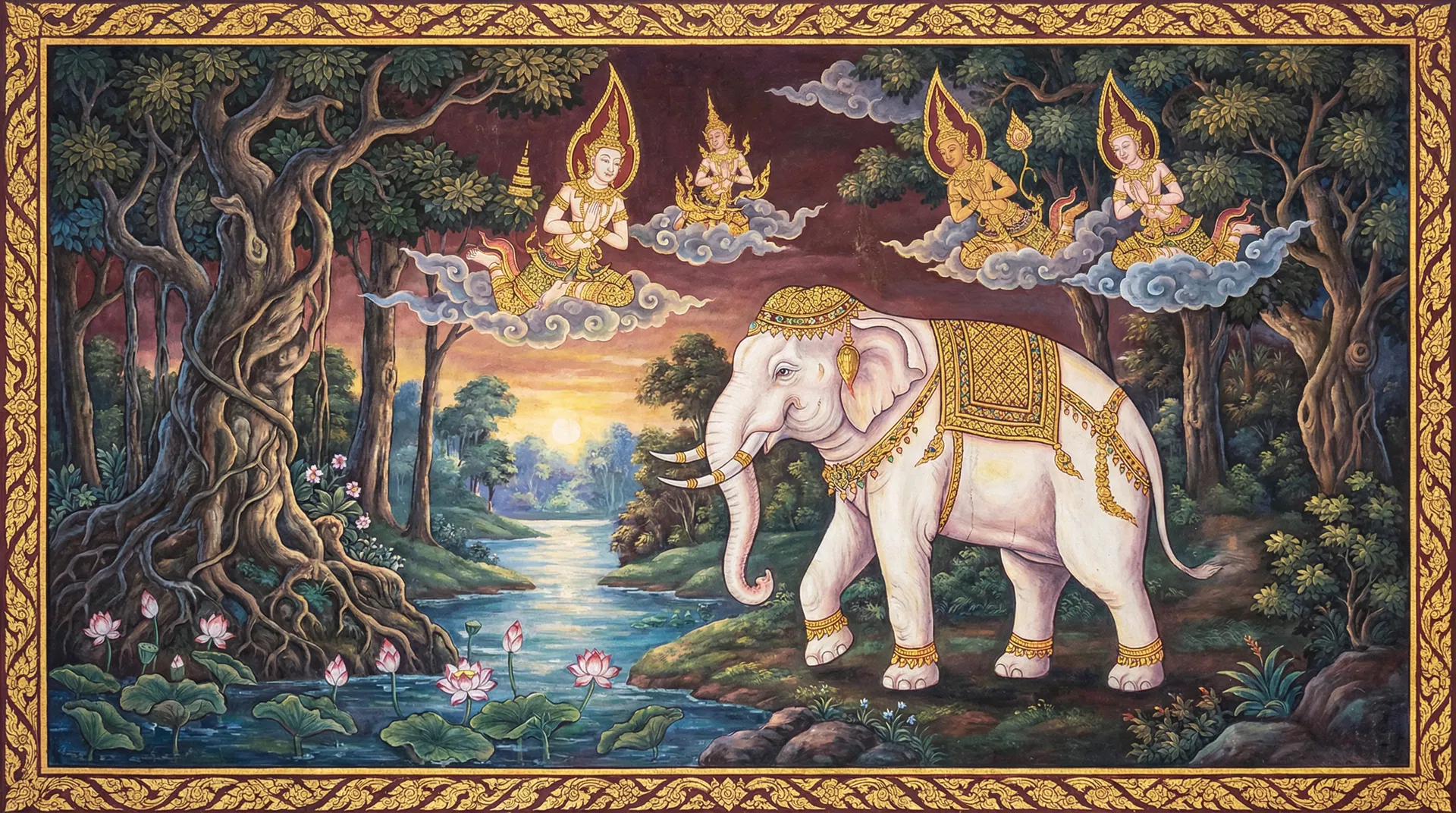
Sākhā Jātaka
Sākhā Jātaka
In the verdant foothills of the Himalayas, where ancient trees whispered secrets to the wind, lived a family of monkeys. The patriarch of this troop was a wise old monkey named Sākhā, whose fur was the color of twilight and whose eyes held the depth of a thousand dawns. Sākhā was not just old; he was revered for his profound understanding of the forest and its ways. He knew which fruits were sweetest, which roots were most nourishing, and more importantly, he knew the subtle signs of danger.
One sweltering summer, a great fire swept through the forest. Fueled by dry leaves and strong winds, it raged with terrifying intensity, devouring everything in its path. The monkeys, panicked and disoriented, scattered in all directions, their usual agility replaced by sheer terror. Sākhā, however, remained calm amidst the chaos.
He gathered the younger monkeys, his voice a steady beacon in the inferno. "My children," he called out, his voice firm despite the smoke choking the air, "Do not run blindly! Look to the river! The water is our salvation!"
Most of the monkeys, blinded by fear, ignored his pleas. They scrambled up trees that were soon engulfed in flames, or plunged into thickets that offered no escape. A few, however, trusted Sākhā’s wisdom. They followed him, leaping from branch to branch, their small hearts pounding against their ribs.
The fire was relentless. It crackled and roared, a monstrous beast consuming the forest. Sākhā led his small band with extraordinary skill, dodging falling embers and leaping over burning logs. He guided them towards the great river that flowed miles away, a shimmering promise of safety.
As they neared the riverbank, the heat became unbearable. The air was thick with smoke, and the roar of the fire deafening. The monkeys were exhausted, their fur singed, their lungs burning. Some began to falter, their hope dwindling with every panting breath.
"Hold on!" Sākhā urged, his own strength failing. "Just a little further! The water is so close!"
Finally, they reached the river. With desperate leaps, they plunged into the cool, life-giving water. They swam with all their might, putting as much distance as possible between themselves and the fiery destruction.
As they rested on the opposite bank, gasping for air and gazing back at the inferno that had consumed their home, they saw a tragic sight. Hundreds of monkeys, who had not heeded Sākhā’s warning, were trapped. They had climbed trees that were now burning furiously, their screams lost in the roar of the flames. They had run into dense undergrowth, only to be overcome by smoke and heat.
Sākhā watched with a heavy heart. He had done all he could. He had offered his wisdom, his guidance, his leadership. But he could not force anyone to listen. He had saved those who had the wisdom to trust him, but the others, lost in their fear and disbelief, had met a terrible fate.
The surviving monkeys, huddled together on the riverbank, looked at Sākhā with profound gratitude and sorrow. They understood the value of his foresight and the tragic consequence of ignoring wise counsel.
From that day on, the surviving troop of monkeys never forgot Sākhā's lesson. They learned that in times of crisis, it is not panic but wisdom and trust that lead to safety. They understood that a true leader not only possesses knowledge but also the ability to inspire confidence and guide others through the darkest of times, even when their own strength is tested to its limits.
The scorched forest eventually began to heal, and new life sprouted from the ashes. But the memory of the great fire and the wisdom of Sākhā remained etched in the hearts of the surviving monkeys, a testament to the power of foresight and the folly of succumbing to fear.
— In-Article Ad —
💡Moral of the Story
In times of danger, wise counsel and trust are essential for survival; succumbing to panic and ignoring guidance often leads to disaster.
Perfection: Wisdom (Paññā)
— Ad Space (728x90) —
More Jataka Tales You May Enjoy
 533Mahānipāta
Kusa Jātaka
Kusa JātakaIn the ancient kingdom of Kampilla, ruled a just and virtuous king named Okkāka. His reig...
💡 Integrity and truth will always prevail over deceit and envy. True nobility lies not in birthright, but in character, compassion, and the unwavering commitment to justice, even when faced with personal adversity.
 194Dukanipāta
Kusajataka
Kusajataka In the ancient kingdom of Kasi, nestled amidst rolling hills and fertile plains, ruled a ...
💡 True healing and lasting happiness come from cultivating inner virtues like compassion, selfless love, and mindfulness. Our intentions and the purity of our heart are powerful forces for transformation.
 78Ekanipāta
The Jataka Tale of the Lion's Wisdom
The Jataka Tale of the Lion's Wisdom In the ancient city of Varanasi, a place renowned for its gran...
💡 Intelligence, the ability to see opportunities, and the courage to face risks can lead to wealth and benefit society.
31EkanipātaThe Bodhisatta as a King of Elephants
The Bodhisatta as a King of ElephantsIn the heart of a vast and verdant forest, where ancient trees ...
💡 Wise leadership, determination, and the ability to inspire trust can guide a community through perilous journeys to safety.
35EkanipātaThe Bodhisatta as the Wise Prince Kumara
The Bodhisatta as the Wise Prince Kumara In the ancient kingdom of Mithila, nestled amidst verdant ...
💡 Greed and evil thoughts erode virtue and goodness, like poison destroying the fragrance of the Kandapala tree. Deceiving others leads to ruin.
40EkanipātaThe Parrot Jataka
In a time long past, when the Bodhisatta was reborn as a parrot, his plumage was the vibrant green o...
💡 Actions, driven by intention, have profound and lasting consequences, and a life of virtue leads to true happiness and liberation.
— Multiplex Ad —