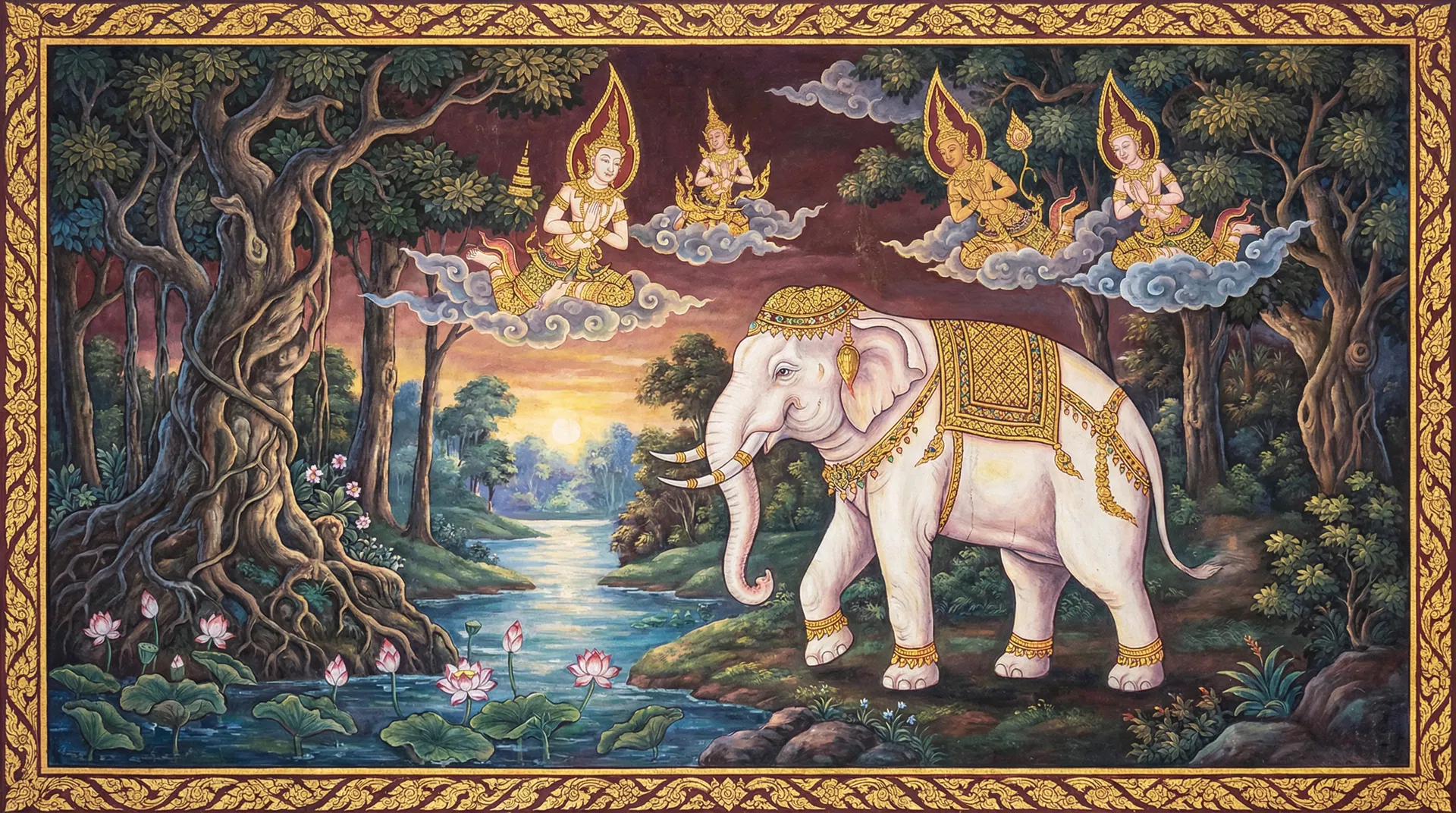
Mūgapakkha Jātaka
Mūgapakkha Jātaka
In the sun-drenched land of Mithila, ruled a king named Brahmadatta, a monarch whose heart was as vast and generous as the sky. Yet, a shadow loomed over his otherwise glorious reign – the king had a peculiar affliction: he was born mute. His voice, though his own, was trapped within him, unable to escape the confines of his throat. This silence, however, did not diminish his wisdom; his eyes spoke volumes, his gestures conveyed profound thoughts, and his actions demonstrated an unparalleled understanding of his kingdom's needs. The people of Mithila loved him dearly, understanding his silent pronouncements with a devotion that transcended mere words.
One day, a wicked Brahmin, consumed by envy and a thirst for power, arrived at the royal court. He saw the king's silence not as a challenge, but as an opportunity. This Brahmin, a master of deception, approached the king with a cunning plan. 'Your Majesty,' he began, though the king could not reply, his eyes piercing the Brahmin's every word, 'I possess a secret, a magical incantation that can grant the gift of speech. But it comes at a price. I must have access to the royal treasury, for the ingredients are rare and costly.'
The king, though unable to utter a sound, possessed a keen intellect. He observed the Brahmin closely, noticing the greed glinting in his eyes, the smugness in his posture. He recognized the snake in the grass, the wolf in sheep's clothing. He knew this man sought not to help him, but to plunder his kingdom. Yet, he did not reveal his suspicion. Instead, he nodded his head, feigning agreement. The Brahmin, mistaking the king's silence for simplemindedness, was overjoyed. He saw his path to riches laid bare.
The Brahmin, under the guise of preparing the magical elixir, began to pilfer from the treasury. He would take small amounts at first, then larger, his greed growing with each successful theft. He believed he was outsmarting the mute king, unaware that the king was merely playing along, observing and waiting for the opportune moment.
Meanwhile, the Bodhisatta, in a previous existence, was a wise elder in the king's court, a close advisor known for his sagacity and unwavering loyalty. He, too, observed the Brahmin's avarice. He saw the king's silent strategy and admired his patience. The Bodhisatta understood that the king was allowing the Brahmin to dig his own grave.
One evening, as the Brahmin, emboldened by his successes, was about to abscond with a particularly large haul of jewels, the king gave a subtle signal to his trusted guards. They had been watching, waiting for the perfect moment. The Brahmin was apprehended, caught red-handed, his deceit exposed for all to see. The king, with a flick of his wrist, gestured for the stolen treasures to be returned, and for the Brahmin to be banished from the kingdom, never to return.
The people rejoiced at the king's cleverness. His silence, which the Brahmin had seen as a weakness, had become his greatest strength. The king, through his astute observation and strategic patience, had protected his kingdom and exposed a villain without uttering a single word. The Bodhisatta, witnessing this, saw the profound truth: that true wisdom is not always loud; it often resides in quiet observation, in careful planning, and in the courage to act decisively when the moment is right.
— In-Article Ad —
💡Moral of the Story
True wisdom is revealed not through eloquent speech, but through careful observation, strategic patience, and decisive action.
Perfection: Patience (Khanti Paramita)
— Ad Space (728x90) —
More Jataka Tales You May Enjoy
 384Chakkanipāta
Mahāpaduma Jātaka
Mahāpaduma Jātaka In the ancient and prosperous kingdom of Mithila, ruled King Janaka, a monarch who...
💡 Lust, deceit, and false accusations lead to immense suffering, while truth, justice, and forgiveness ultimately prevail.
392ChakkanipātaMoggallana Jataka
Moggallana JatakaIn the ancient land of Savatthi, there lived a wealthy merchant named Punna. He was...
💡 Generosity and devotion to the Dharma are powerful virtues that lead to immense merit and spiritual growth. True wealth is found in giving.
 459Ekādasanipāta
Pāṇḍava Jātaka
Pāṇḍava JātakaIn a forgotten era, when the world was young and the gods walked among mortals, there ...
💡 Steadfast integrity, truthfulness, and unwavering loyalty are the strongest defenses against deceit and malice. Inner strength can overcome external threats.
321CatukkanipātaNimi Jataka
Nimi JatakaIn the ancient city of Mithila, ruled a just and benevolent king named Nimi. His reign wa...
💡 Even the highest heavens are impermanent, and true, lasting happiness is found not in external pleasures or celestial abodes, but in the cultivation of inner wisdom, compassion, and detachment through the practice of the Dharma.
317CatukkanipātaSutasoma Jataka
Sutasoma JatakaIn the ancient kingdom of Gandhara, nestled amidst rolling hills and verdant valleys,...
💡 True liberation from suffering comes through selfless sacrifice and detachment from worldly attachments, particularly the craving for existence.
 367Pañcakanipāta
SAMUDDAPALA JATAKA
SAMUDDAPALA JATAKAIn the ancient city of Varanasi, where the Ganges flowed like a silver ribbon, liv...
💡 True leadership lies in selfless sacrifice for the well-being of the people. Compassion and virtue have the power to transform even the most avaricious hearts and bring about lasting prosperity.
— Multiplex Ad —