The Monkey King Jataka
The Monkey King Jataka
In the verdant expanse of the Himalayan foothills, where ancient trees whispered secrets to the wind and crystal-clear rivers flowed, there once lived a king who was also a Bodhisattva, in the form of a wise and noble Monkey King. This king ruled over a vast troop of monkeys, each one loyal and obedient, living in harmony amidst the lush forests. The Monkey King was known for his exceptional strength and his unparalleled ability to leap from treetop to treetop, a skill that set him apart even amongst his agile kin.
One sweltering day, a severe drought descended upon the land. The rivers dwindled to trickles, the leaves on the trees began to wither, and the once-vibrant forest turned into a parched, dusty wasteland. The monkeys, weakened by thirst and hunger, looked to their king with despair in their eyes. "Oh, our great King," they pleaded, their voices hoarse, "what shall become of us? Our thirst is unbearable, and our strength fails us." The Monkey King, his heart heavy with the suffering of his troop, surveyed the desolate landscape. He knew he had to do something, anything, to save his people.
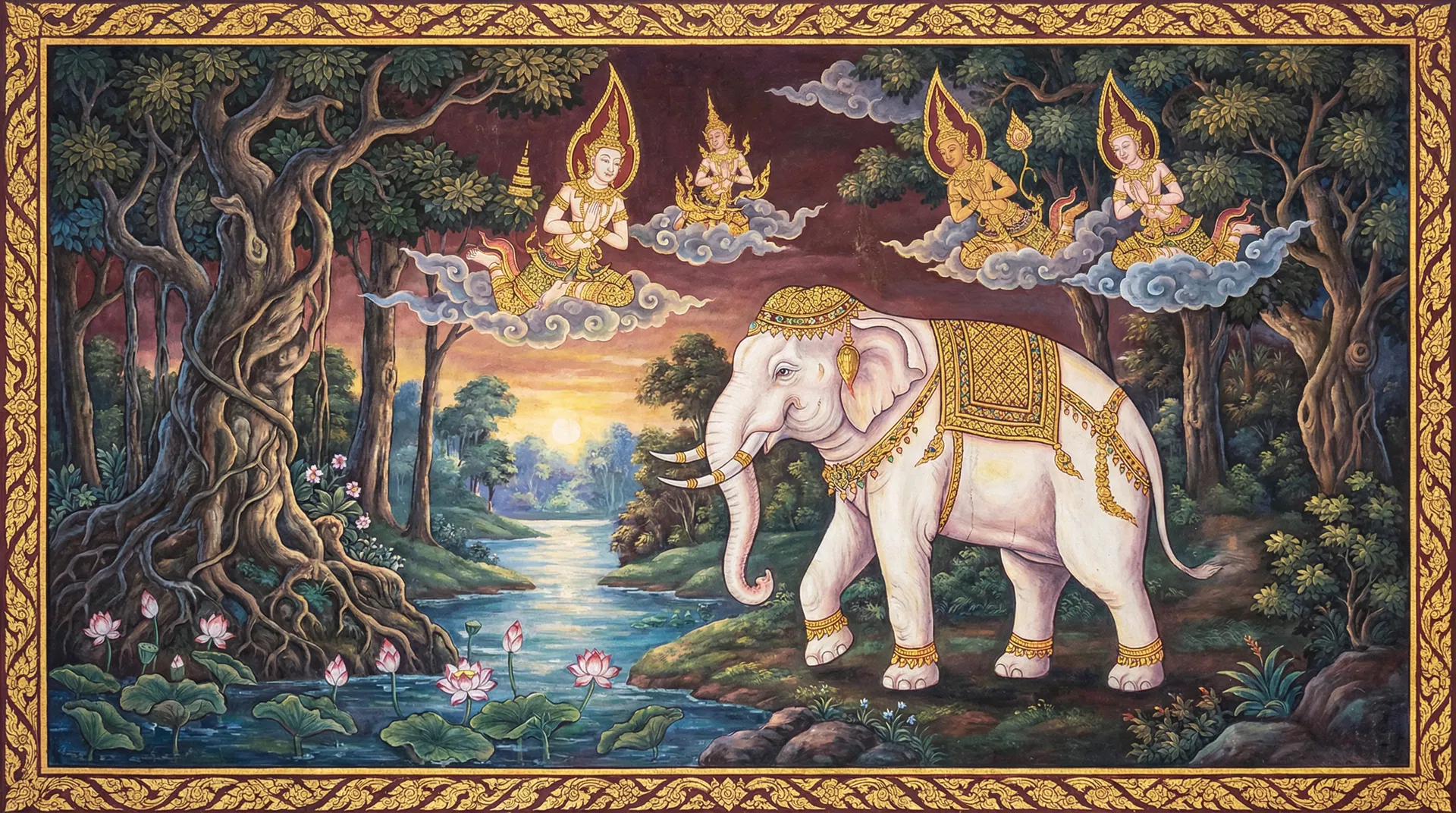
He led his troop to the foot of a towering, ancient banyan tree, its branches stretching towards the sky like gnarled fingers. This tree was known for its immense size and its deep, life-giving roots. The Monkey King, with a determined glint in his eye, climbed to the very highest branch, its leaves rustling in the faint breeze. He took a deep breath, gathering all his strength, and leaped. It was a leap of immense distance, a testament to his extraordinary power. He soared through the air, his body a blur against the hazy sky, aiming for a distant, sturdy branch of another massive tree.
However, the jump was too ambitious, too far. The Monkey King's strength, though great, was not enough. His grip faltered, and he began to fall. As he tumbled through the air, he saw the desperate faces of his troop below, their hopes pinned on his every move. In that moment, he knew his life was forfeit. He would rather die than betray their trust. With his last ounce of energy, he stretched out his body, creating a bridge between the two trees. His body became a living, sturdy beam, allowing his followers to escape across his outstretched form to safety.
The monkeys, shocked and heartbroken, hesitated. They could not bear to tread upon their king, their savior. But the Monkey King, with a weak but resolute voice, urged them on. "My beloved troop," he gasped, "cross over! Live! My life is but a small price for your survival." Moved by his sacrifice, yet compelled by his command, the monkeys, one by one, scurried across his body to reach the safety of the other tree. As the last monkey made it to safety, the Monkey King's strength gave out, and he fell to the ground, his life extinguished.
News of the Bodhisattva's sacrifice reached the ears of the gods. Moved by his selfless act of compassion and his unwavering commitment to his followers, the gods were deeply touched. They recognized the immense merit and virtue displayed by the Monkey King. In their wisdom, they ensured that his noble act would not be forgotten. The banyan tree, where his leap had begun, was said to have been blessed, its roots miraculously finding water, sustaining the remaining life in the forest. The other tree, now connected by the memory of his sacrifice, became a symbol of hope and resilience.
The story of the Monkey King's sacrifice became a legend, passed down through generations. It was a tale that spoke of true leadership, of the profound responsibility a leader has towards their people, and the ultimate sacrifice one might make for the greater good. The monkeys, though mourning their king, lived on, forever inspired by his courage and his boundless love.
— In-Article Ad —
💡Moral of the Story
True leadership lies in selfless sacrifice for the well-being and survival of one's followers, embodying compassion and unwavering commitment.
Perfection: Generosity (Dana) and Courage (Virya)
— Ad Space (728x90) —
More Jataka Tales You May Enjoy
 215Dukanipāta
Cullabodhi Jataka
The Courage of ConvictionIn the vibrant city of Savatthi, lived a prince named Bodhi. He was not the...
💡 True courage lies in upholding justice and compassion, even in the face of opposition. Lasting order and prosperity are built on mercy and understanding, not on fear and harshness.
 496Pakiṇṇakanipāta
Mūgapakkha Jātaka
Mūgapakkha JātakaIn the ancient kingdom of Mithila, nestled amidst lush green hills and crystal-clea...
💡 True wisdom and effective communication can manifest in ways beyond spoken words, such as through actions, illustrations, and deep understanding.
 114Ekanipāta
Cūḷaka-Seṭṭhi Jātaka
Cūḷaka-Seṭṭhi Jātaka In the ancient city of Mithila, a bustling hub of trade and commerce, lived a w...
💡 True wealth is not measured by possessions, but by the generosity of spirit and the goodwill cultivated through acts of kindness. Giving with a pure heart brings greater abundance.
157DukanipātaSasa Jataka
Sasa JatakaLong, long ago, in a time when the stars seemed closer and the moon cast a gentler glow, ...
💡 True virtue lies not in what one possesses, but in the willingness to give selflessly for the benefit of others.
156DukanipātaDhopa Jataka
Dhopa JatakaIn the ancient kingdom of Mithila, renowned for its flourishing arts and discerning popu...
💡 Do not be fooled by superficial allurements and intoxicating fragrances; seek that which is pure, genuine, and lasting.
145EkanipātaMahosadha Jataka
The Tale of Mahosadha, the Wisest of All In the ancient city of Mithila, under the reign of King Ved...
💡 Profound wisdom, applied with compassion and foresight, can bring peace, prosperity, and justice to a kingdom and its people.
— Multiplex Ad —