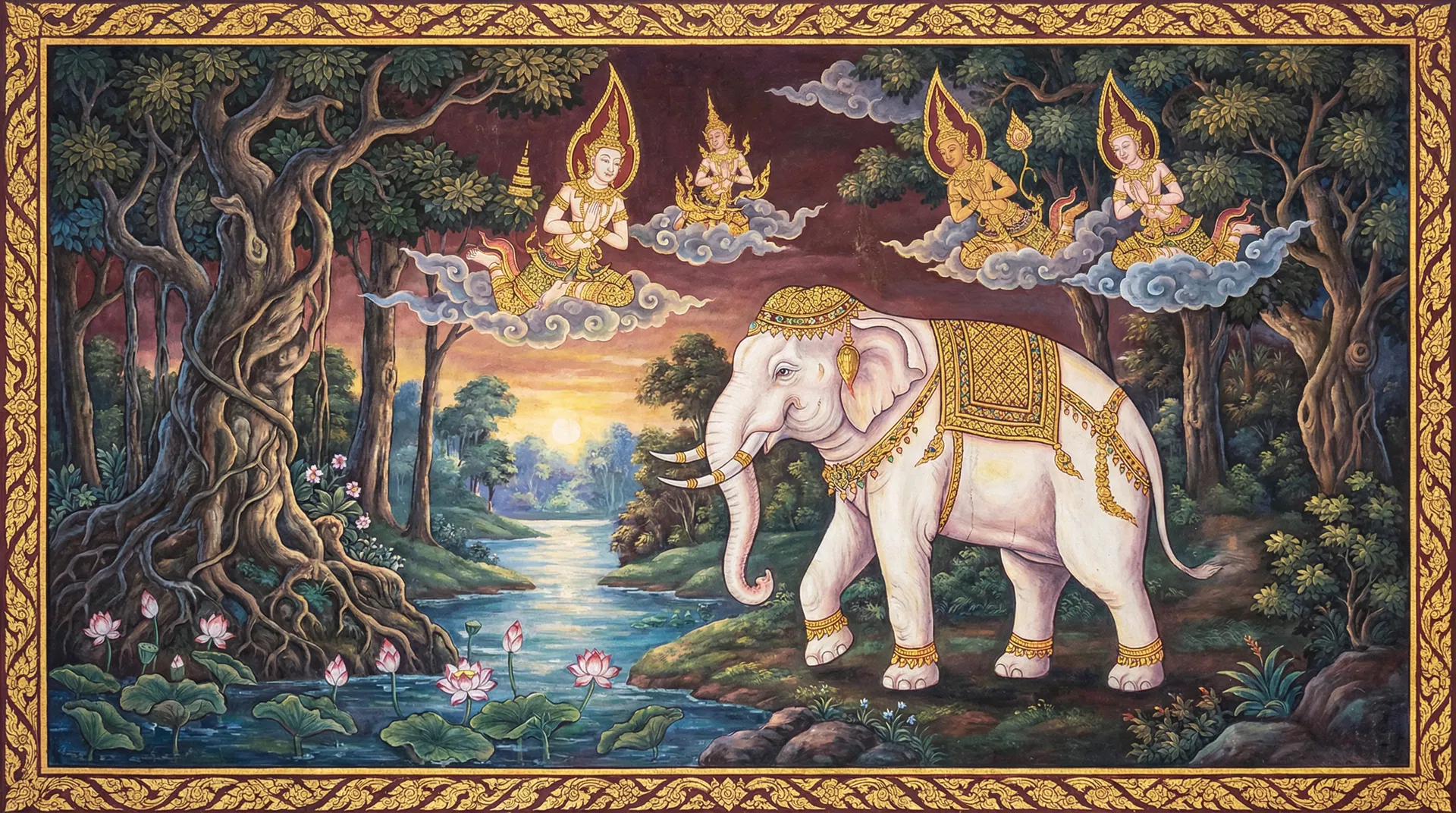
Nimi Jataka
Nimi Jataka
In the ancient city of Mithila, ruled a just and benevolent king named Nimi. His reign was a golden age, where righteousness flourished, and his people lived in peace and prosperity. King Nimi was renowned throughout the land not only for his wisdom and fairness but also for his deep devotion to the Dharma. He upheld the five precepts with unwavering diligence and constantly sought ways to promote virtue and alleviate suffering.
One day, the great god Sakka, ruler of the Tavatimsa heaven, observed the exceptional merit of King Nimi. Impressed by the king's piety and dedication to righteous living, Sakka decided to visit him. He descended from his celestial abode, taking the form of a humble ascetic, and appeared before the palace gates. The guards, seeing the serene aura of the visitor, respectfully ushered him into the royal presence.
King Nimi, ever gracious, welcomed the ascetic. "Venerable sir, what brings you to my humble court?" he inquired, bowing his head. The ascetic, with a gentle smile, replied, "Great king, I have come to offer you a special invitation. The gods in Tavatimsa heaven are holding a grand festival, and they wish for you to join them. Your virtuous deeds have earned you a place among us, if only for a brief sojourn."
King Nimi was overjoyed. To be invited to the heavenly realms was an honor beyond measure. He thanked Sakka profusely and agreed to go. Sakka then instructed him on how to ascend. "When the time comes, simply think of me, and a divine chariot will appear to carry you to the Tavatimsa heaven." With these words, Sakka vanished as mysteriously as he had appeared.
King Nimi, eager to fulfill his promise, began to prepare for his heavenly journey. He appointed a regent to govern the kingdom in his absence and made arrangements for his family. He then sat in his royal chamber, closed his eyes, and invoked Sakka. In an instant, a magnificent celestial chariot, adorned with shimmering jewels and drawn by pure white horses, materialized before him. With a heart filled with anticipation, King Nimi boarded the chariot, and it soared into the sky, carrying him towards the heavens.
Upon arriving in Tavatimsa, King Nimi was greeted by Sakka himself, who led him through the celestial city. The sights and sounds were beyond anything the king had ever imagined. The palaces were built of pure gold and precious gems, the gardens bloomed with flowers of unimaginable beauty, and the air was filled with the melodious sounds of heavenly music. The gods, radiant and joyful, welcomed King Nimi and treated him as an honored guest. He witnessed celestial dances, listened to divine discourses, and participated in joyous celebrations.
During his stay, King Nimi observed the lives of the gods. He saw their immense happiness and their luxurious existence, but he also noticed something else. He saw that even in heaven, their happiness was not eternal. It was dependent on their accumulated merit from past lives. When their merit waned, they would eventually fall back into lower realms. He also observed that their actions, though often pleasant, were not always rooted in the profound wisdom and compassion that characterized his own practice of the Dharma on Earth.
After a period of joyous revelry, King Nimi felt a pull towards his earthly duties. He had seen enough of the heavenly realms and yearned to return to his kingdom and his people. He informed Sakka of his desire to depart. Sakka, understanding the king's noble heart, granted his request. He bade farewell to the king and gifted him a divine flower, a symbol of their friendship and a reminder of his heavenly visit. The celestial chariot reappeared, and King Nimi descended back to Mithila.
Upon his return, King Nimi was greeted with immense relief and joy by his subjects. He resumed his reign, but his perspective had been profoundly changed. The experiences in Tavatimsa had solidified his understanding of the impermanent nature of all existence, even in the highest heavens. He realized that true and lasting happiness was not to be found in sensual pleasures or celestial abodes, but in the cultivation of inner peace, wisdom, and compassion through the practice of the Dharma.
King Nimi redoubled his efforts to live a life of virtue. He focused on cultivating detachment, practicing generosity with an even greater heart, and striving for perfect equanimity. He understood that while good deeds brought pleasant results, the ultimate liberation came from transcending the cycle of rebirth altogether. He often spoke to his court about the impermanence of all things and the importance of seeking refuge in the Dharma. The divine flower Sakka had given him he kept in his royal chamber, a constant reminder of his journey and the lessons learned.
One day, a wise sage, who had lived a long life of austerity and meditation, approached King Nimi. He had heard of the king's heavenly sojourn and was curious about the wisdom he had gained. The sage asked, "O King, you have visited the realms of the gods. Tell me, what is the greatest treasure one can possess?"
King Nimi, with a calm and serene expression, replied, "Venerable sir, the greatest treasure is not gold, nor jewels, nor even a heavenly kingdom. The greatest treasure is wisdom, the understanding of the true nature of reality, and the cultivation of a mind free from attachment and aversion. It is the ability to live righteously, with compassion for all beings, and to find contentment within oneself, regardless of external circumstances."
The sage was deeply impressed by the king's profound insight. He recognized that King Nimi, despite his royal status, had achieved a state of spiritual maturity that few attain. He blessed the king and departed, spreading the king's wise words throughout the land.
King Nimi continued to rule his kingdom with wisdom and compassion for many more years. His reign became a shining example of how a leader could govern with both worldly success and spiritual depth. He taught his people that true happiness lay not in material possessions or fleeting pleasures, but in the cultivation of virtue, the pursuit of wisdom, and the practice of selfless service. His life served as a beacon, guiding his subjects towards a path of righteousness and inner peace, a path that led not just to happiness in this life, but to a more favorable destiny in future existences.
— In-Article Ad —
💡Moral of the Story
Even the highest heavens are impermanent, and true, lasting happiness is found not in external pleasures or celestial abodes, but in the cultivation of inner wisdom, compassion, and detachment through the practice of the Dharma.
Perfection: Wisdom (Panna)
— Ad Space (728x90) —
More Jataka Tales You May Enjoy
 120Ekanipāta
Sibi Jataka
Sibi Jataka In the ancient kingdom of Sibi, nestled amidst fertile plains and blessed with bountiful...
💡 The highest form of compassion and truthfulness involves selfless sacrifice for the well-being of others. True virtue transcends natural laws and personal comfort, earning immeasurable merit and inspiring all.
115EkanipātaMittavindaka Jātaka
Mittavindaka Jātaka In the bustling city of Savatthi, there lived a wealthy merchant named Mittavind...
💡 Extreme stinginess leads to isolation, regret, and a life devoid of true happiness. Generosity and compassion are the real treasures that enrich life.
 413Sattakanipāta
Sankha-Jataka
Sankha-JatakaIn the bustling city of Varanasi, amidst a labyrinth of narrow lanes and vibrant market...
💡 True wealth is not measured in material possessions, but in the knowledge and compassion that enable us to serve others and alleviate suffering. Youthful impetuosity, if unchecked, can lead to great regret.
129EkanipātaMora Jataka
Mora JatakaIn the heart of a dense and ancient forest, where sunlight struggled to pierce the thick ...
💡 True power lies not in physical strength or material possessions, but in the purity of virtue, the wisdom of compassion, and the ability to inspire transformation through truth.
 159Dukanipāta
Nimi Jataka
Nimi JatakaIn the ancient land of Videha, there ruled a king named Nimi. King Nimi was a paragon of ...
💡 Understanding the law of karma and the consequences of one's actions is essential for cultivating virtue and progressing towards liberation.
162DukanipātaKusa Jataka
The Story of the Golden Deer and the Loyal PrinceIn the ancient land of Mithila, the King, a just an...
💡 True nobility is demonstrated not by birth, but by one's actions, courage, compassion, and commitment to righteousness. Integrity and self-sacrifice in the face of adversity reveal one's true character.
— Multiplex Ad —