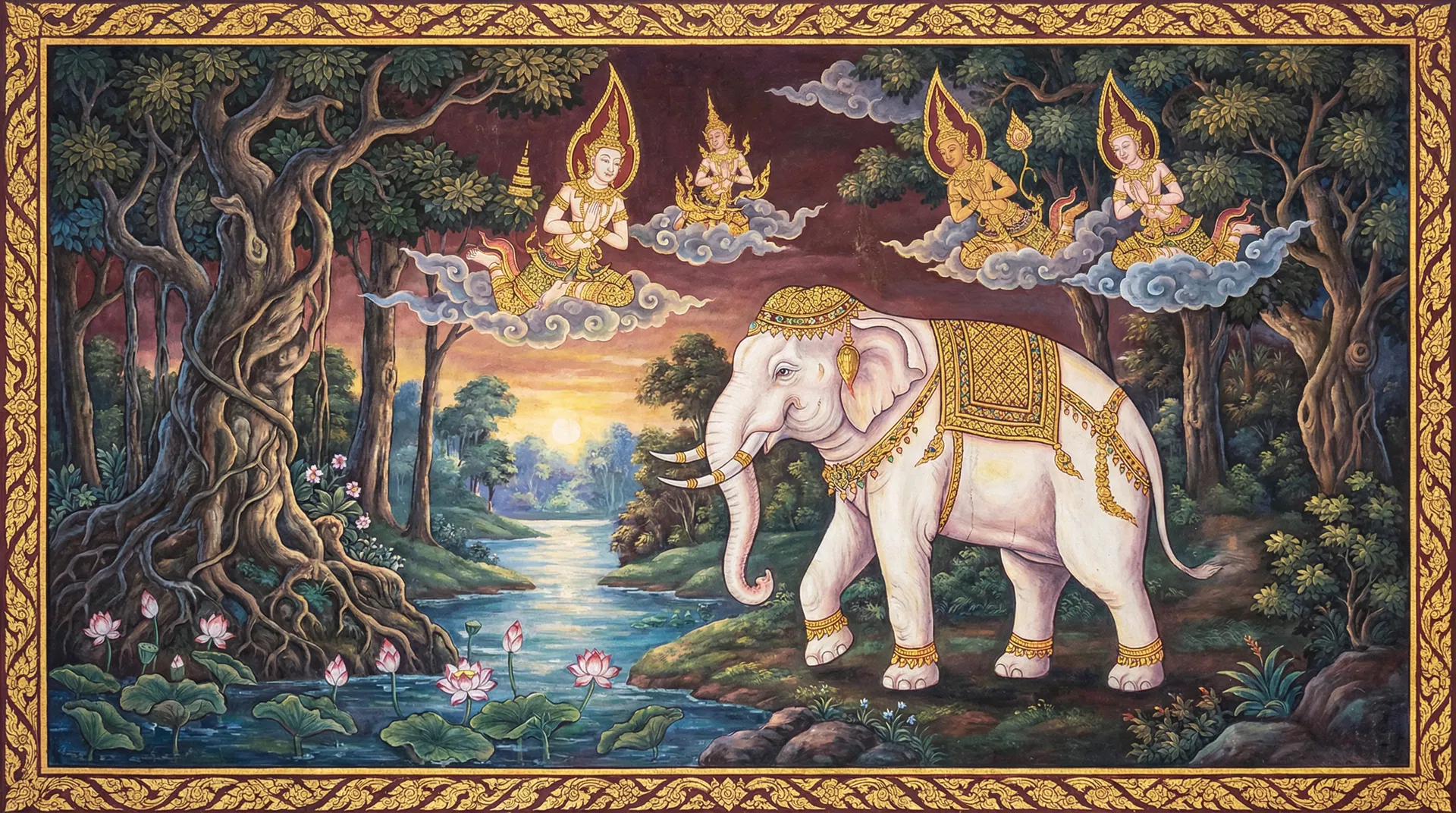
Maha-Ummagga Jataka
Maha-Ummagga Jataka
In the heart of the ancient kingdom of Mithila, under the reign of the wise King Cetiya, lived a prince named Bodhisattva. From the moment he was born, it was clear that this was no ordinary child. His eyes, even in infancy, held a profound depth, and his understanding of the world seemed innate. As he grew, his intelligence blossomed like a lotus in a royal pond. He possessed an extraordinary capacity for logic, a remarkable memory, and an unparalleled ability to foresee consequences. He was, in essence, the embodiment of wisdom, destined to guide his kingdom through any storm.
The king, recognizing the immense potential in his son, ensured that the prince received the finest education. He was tutored by the most learned scholars, exposed to the intricacies of statecraft, philosophy, and the sciences. But it was the prince's own mind, his sharp intellect and his insatiable curiosity, that truly set him apart. He would spend hours contemplating complex problems, devising ingenious solutions that often surpassed the understanding of his teachers.
One of the greatest challenges that beset Mithila was the constant machinations of its neighboring kingdom, ruled by the ambitious and often deceitful King Kalinda. Kalinda, envious of Mithila's prosperity and peace, continuously sought to sow discord and to find weaknesses that he could exploit. He sent spies, spread false rumors, and devised intricate plots, all aimed at undermining King Cetiya's reign.
The prince, though young, was the king's most trusted advisor. He would meticulously analyze Kalinda's moves, often predicting them days in advance. One such instance involved a cunning ploy by Kalinda to frame a loyal minister of King Cetiya. Kalinda's spies planted stolen jewels in the minister's chambers, intending to have him accused of treason.
The prince, however, had been suspicious of Kalinda's sudden 'gifts' of rare spices to the minister. He deduced that the spices might have been used to attract rodents, and that Kalinda's men had used this opportunity to plant the evidence. When the minister was brought before the king, accused and trembling, the prince stepped forward. He calmly explained his reasoning, then instructed the royal guards to examine the minister's storeroom. There, hidden amongst the spice sacks, they found small, meticulously crafted hollow reeds, designed to carry the jewels undetected. The prince's foresight and logical deduction exposed the plot, saving the innocent minister and thwarting Kalinda's treachery.
Another time, Kalinda sent a beautiful but poisonous snake to the king, disguised as a rare pet. The king was enchanted by the creature, but the prince, noticing the unusual stillness and the peculiar sheen of its scales, grew suspicious. He remembered ancient texts describing serpents from the venomous lands of Kalinda. He intervened just as the king was about to stroke the creature, explaining the danger. He then devised a method to neutralize the venom, thus saving the king's life once more.
The prince's wisdom extended beyond matters of security. He implemented innovative agricultural techniques, advised on fair trade practices, and resolved complex legal disputes with impeccable fairness and logic. He understood that true leadership lay not just in defending the kingdom, but in nurturing its growth and ensuring the well-being of every citizen. He established a system of public granaries to ensure no one starved during times of famine, and he created a council of elders to advise on matters affecting the common people.
His most celebrated act, however, was during a time of great drought. When the rivers dried up and the land cracked, despair threatened to engulf the kingdom. While others prayed for rain, the prince delved into ancient geological surveys and consulted forgotten texts. He discovered the existence of a vast underground aquifer, a hidden reservoir of water deep beneath the earth. He then designed an ingenious system of wells and underground channels, a colossal undertaking that required immense coordination and labor. Under his direct supervision, the project was completed, bringing life-giving water to the parched lands and saving the kingdom from ruin.
The prince's reign, though not explicitly detailed as a separate ruler in this narrative, was implicitly the period when his wisdom guided the kingdom. He demonstrated that the greatest strength of a nation lies in the intelligence, foresight, and compassion of its leaders. The Maha-Ummagga Jataka, meaning 'The Great Tunnel Jataka', refers to his monumental feat of bringing water, symbolizing how his wisdom created paths where none seemed to exist, tunneling through ignorance and despair to bring forth life and prosperity.
— In-Article Ad —
💡Moral of the Story
Profound intelligence, foresight, and logical reasoning are essential for effective leadership, capable of overcoming even the most daunting challenges and ensuring the prosperity and well-being of a kingdom.
Perfection: Wisdom Perfection (Panna Paramita)
— Ad Space (728x90) —
More Jataka Tales You May Enjoy
 516Vīsatinipāta
Mugapakkha Jataka
The Tale of the Mute BodhisattaIn a time long past, when the world was a tapestry woven with the thr...
💡 True wealth lies not in material possessions, but in the compassion and willingness to share with those in need. Profound wisdom can be cultivated in silence, and the right moment will reveal one's true voice and purpose.
 162Dukanipāta
Kusa Jataka
The Story of the Golden Deer and the Loyal PrinceIn the ancient land of Mithila, the King, a just an...
💡 True nobility is demonstrated not by birth, but by one's actions, courage, compassion, and commitment to righteousness. Integrity and self-sacrifice in the face of adversity reveal one's true character.
 37Ekanipāta
The Golden Peacock Jataka
In a verdant land of Kasi, blessed with abundant forests and mountains, the Bodhisatta was once rebo...
💡 True wisdom lies in understanding different paths and cultivating inner peace and resilience, rather than clinging to narrow prejudices.
145EkanipātaMahosadha Jataka
The Tale of Mahosadha, the Wisest of All In the ancient city of Mithila, under the reign of King Ved...
💡 Profound wisdom, applied with compassion and foresight, can bring peace, prosperity, and justice to a kingdom and its people.
183DukanipātaMuḷapariyāya Jātaka
The Tale of the Root of All EvilIn the ancient and prosperous city of Varanasi, ruled a king named B...
💡 The root of all suffering and evil lies within the human mind, stemming from craving, attachment, and ignorance. True peace is found by understanding and overcoming these internal afflictions.
137EkanipātaMaha-Ummagga Jataka
The Great Wisdom of Prince VessantaraIn the ancient kingdom of Kalinga, famed for its glittering cit...
💡 The highest form of generosity is to give even that which is most precious, understanding that true happiness lies in selfless giving and compassion for all beings.
— Multiplex Ad —