
Mahosadha Jataka
Mahosadha Jataka
In the ancient city of Mithila, renowned for its bustling marketplaces and magnificent palaces, lived a Bodhisatta named Mahosadha. Even as a child, Mahosadha possessed an intellect so sharp and a wisdom so profound that it astonished all who encountered him. He was not merely intelligent; he was a living embodiment of insightful understanding, able to discern the truth in any situation and offer solutions that were both ingenious and just.
The king of Mithila, Vidudabha, was a ruler of considerable power, but he was often swayed by the counsel of his less scrupulous ministers. It was Mahosadha, with his unwavering dedication to truth and fairness, who often found himself navigating the complex currents of the royal court, guiding the king towards wise decisions and protecting the innocent from injustice.
One of the most memorable instances of Mahosadha's brilliance involved a dispute between two wealthy merchants. One accused the other of stealing a valuable jewel, and the evidence was circumstantial. The ministers, eager to please the king and perhaps influenced by bribes, were leaning towards a swift and harsh judgment. But Mahosadha, observing the proceedings, sensed that something was amiss.
'Your Majesty,' Mahosadha interjected calmly, his voice cutting through the tense atmosphere of the court. 'Before we pass judgment, allow me to conduct a small experiment. Let us bring forth the accuser and the accused, and a sack of rice.'
The king, intrigued by Mahosadha’s unusual request, nodded his assent. The sack of rice was brought in. Mahosadha then instructed the accuser to reach into the sack and retrieve a handful of rice. As the merchant plunged his hand into the grains, Mahosadha watched intently. The accused merchant, meanwhile, stood patiently.
'Now,' Mahosadha said, turning to the accuser, 'tell us, what did you feel when you reached into the sack?'
The accuser, bewildered, stammered, 'I felt... rice, of course. Nothing else.'
Mahosadha then turned to the accused. 'And you, my lord, what did you feel?'
The accused merchant replied, 'I felt nothing but the grains of rice, O wise one.'
Mahosadha smiled, a knowing glint in his eyes. 'Your Majesty,' he announced, 'the thief is the accuser. For if the jewel had truly been stolen and hidden within this sack of rice, the thief, fearing discovery, would have felt a tremor of anxiety, a subtle unease, every time his hand neared the precious object. He would have been hyper-aware of the presence of the stolen goods. But the true owner, the innocent man, felt only the ordinary sensation of rice. The accuser's guilt manifested as a subconscious anticipation of his deceit being revealed, a subtle but palpable reaction to the proximity of the evidence.'
The court was stunned into silence. The accuser, exposed and shamed, confessed his lie. The king, marveling at Mahosadha's ingenuity, proclaimed him the wisest man in his kingdom and entrusted him with the administration of justice.
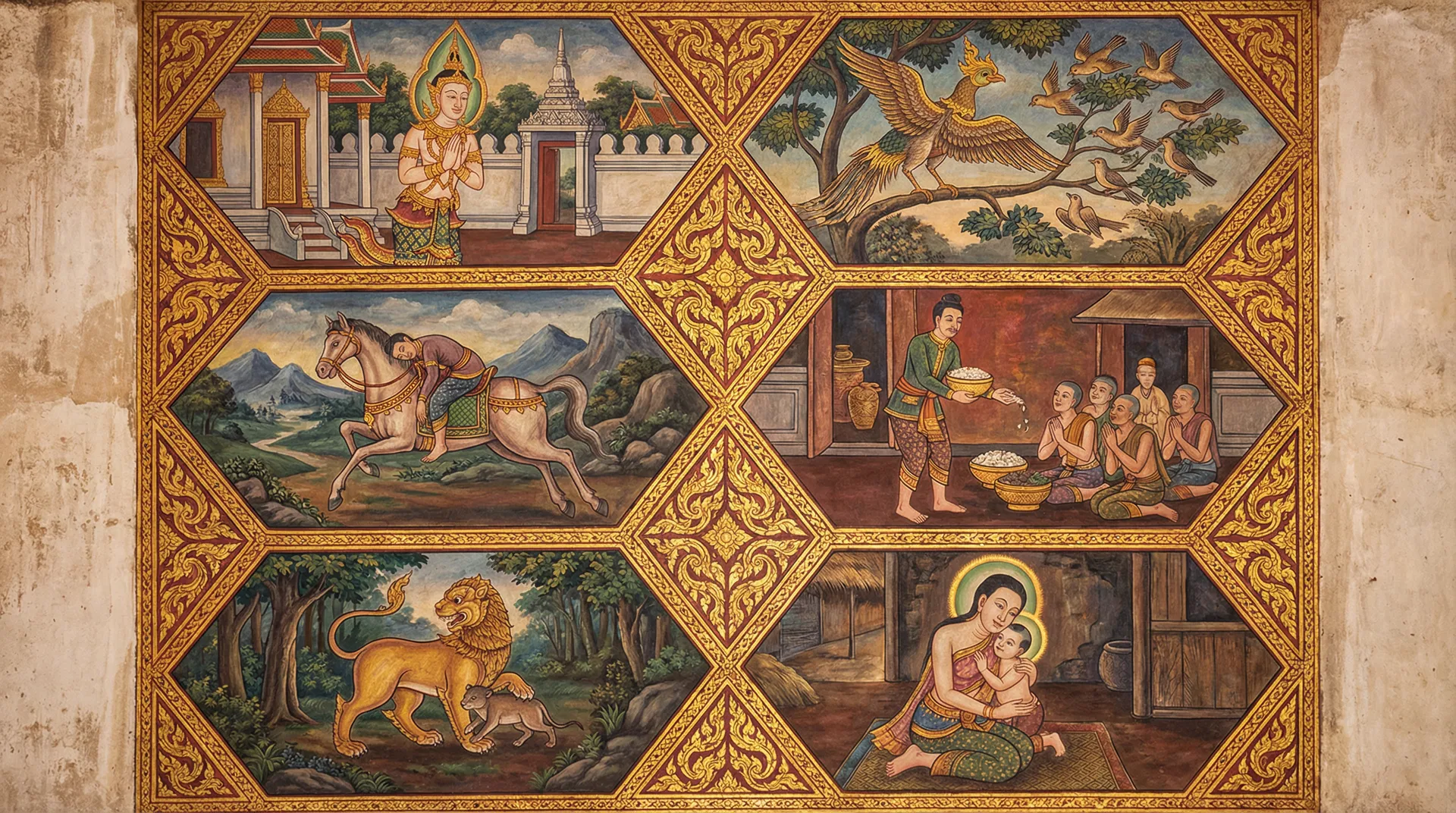
Another time, a dispute arose over a beautiful, spirited horse. Two men claimed ownership, each providing seemingly valid reasons. The ministers were baffled. Mahosadha, however, asked for the horse to be brought before him. He then instructed one of the claimants to call the horse by its name. The man called out, 'Come, my noble steed!' The horse remained indifferent.
Mahosadha then turned to the other man. 'Call the horse,' he commanded.
The second man, with a gentle smile, called out, 'My dear friend, come to me!' Instantly, the horse pricked up its ears, trotted forward, and nudged the man affectionately, as if recognizing its true master. Mahosadha declared him the rightful owner, explaining that the horse's genuine affection and obedience revealed the true bond of companionship.
Through countless such instances, Mahosadha demonstrated his unparalleled wisdom, not just in resolving legal disputes, but in understanding the intricacies of human nature and the natural world. He advised the king on matters of state, on building canals, on planning cities, and on cultivating the land, always with foresight and a deep understanding of cause and effect.
His counsel was sought by neighboring kingdoms, and his reputation for wisdom became legendary. He lived a life dedicated to serving his people, ensuring that justice prevailed and that the kingdom of Mithila prospered under the guidance of his profound intellect and his compassionate heart. The legacy of Mahosadha stands as a testament to the power of wisdom, not just in solving problems, but in building a just and thriving society.
— In-Article Ad —
💡Moral of the Story
True wisdom lies in understanding the heart of matters and the nature of beings, leading to just and insightful solutions.
Perfection: Wisdom (Panna)
— Ad Space (728x90) —
More Jataka Tales You May Enjoy
 392Chakkanipāta
Moggallana Jataka
Moggallana JatakaIn the ancient land of Savatthi, there lived a wealthy merchant named Punna. He was...
💡 Generosity and devotion to the Dharma are powerful virtues that lead to immense merit and spiritual growth. True wealth is found in giving.
 547Mahānipāta
Mahāsutasoma Jātaka
The Tale of the Great Sutasoma In the city of Indapatta, ruled a wise and just king named Pāṭaliputt...
💡 The unwavering commitment to truth, even in the face of death, possesses a transformative power that can overcome the deepest darkness and bring about profound change.
 413Sattakanipāta
Sankha-Jataka
Sankha-JatakaIn the bustling city of Varanasi, amidst a labyrinth of narrow lanes and vibrant market...
💡 True wealth is not measured in material possessions, but in the knowledge and compassion that enable us to serve others and alleviate suffering. Youthful impetuosity, if unchecked, can lead to great regret.
404SattakanipātaSama Jataka
Sama JatakaIn the tranquil foothills of the Himalayas, where the air was crisp and the scent of pine...
💡 Filial piety (devotion to parents) and a life lived with unwavering virtue and sincerity possess immense power, capable of overcoming even the gravest of misfortunes.
 296Tikanipāta
Kacchapa Jataka
The Kacchapa Jataka: The Steadfast Tortoise In the ancient land of Mithila, ruled by a wise and just...
💡 True strength lies not in avoiding hardship, but in enduring it with steadfastness, patience, and unwavering hope. Compassion and perseverance can inspire even the most pragmatic to choose a more humane path.
322CatukkanipātaMahamora Jataka
Mahamora JatakaIn a lush and verdant forest, teeming with life and vibrant with the songs of countle...
💡 True wealth and lasting happiness are not found in material possessions or the satisfaction of greed, but in wisdom, contentment, compassion, and a life lived virtuously. Wisdom and compassion have the power to transform even the most hardened hearts.
— Multiplex Ad —