
Sattigumba-Jātaka
Sattigumba-Jātaka
In the sprawling kingdom of Kasi, renowned for its skilled artisans and vibrant markets, there lived a king named Brahmadatta. He was a just and prosperous ruler, but he possessed a particular fondness for hunting, often venturing into the dense forests surrounding his capital in pursuit of game. During one such expedition, accompanied by his royal retinue, the king found himself drawn deep into an unfamiliar part of the jungle.
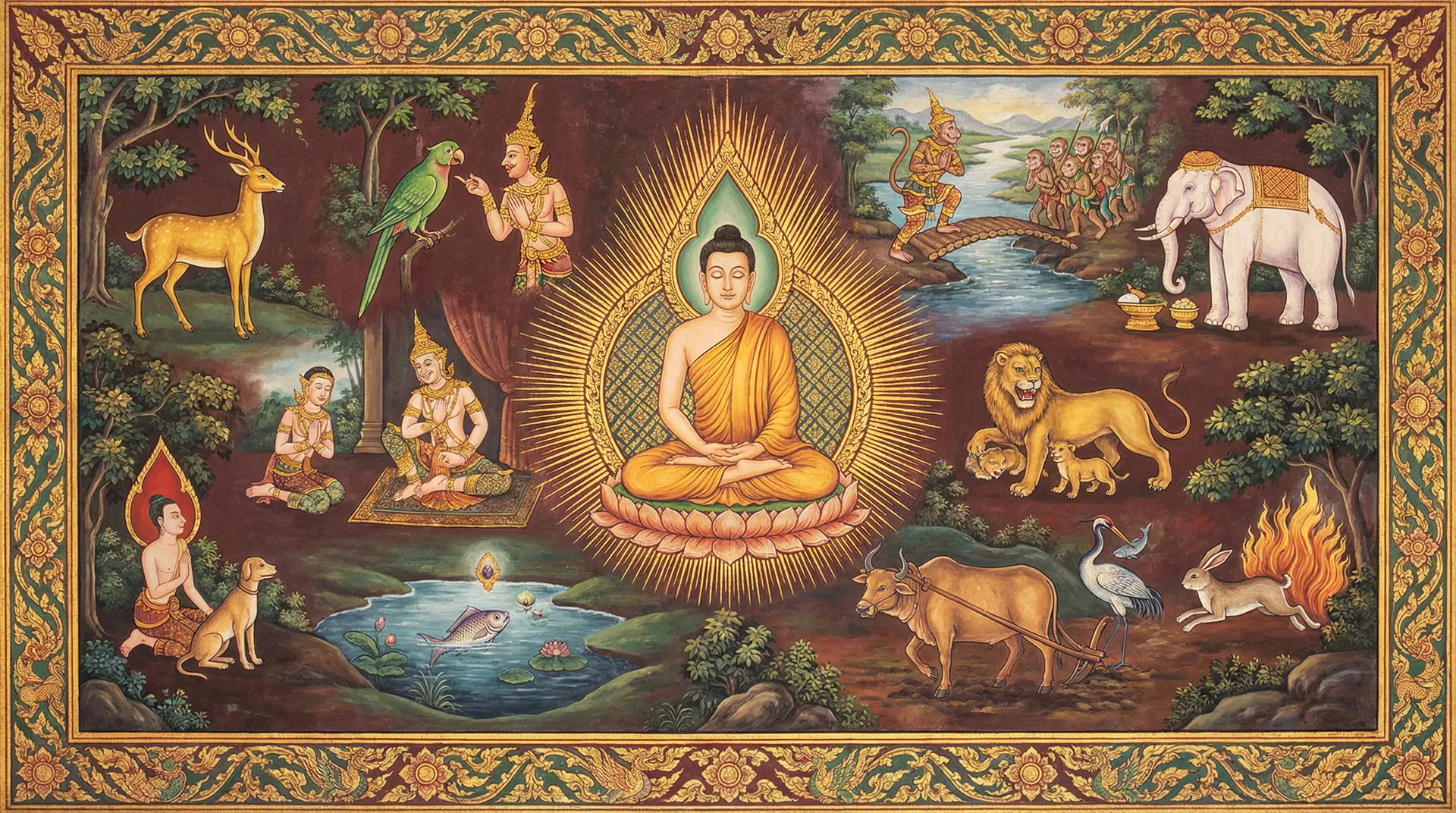
As they ventured further, the king and his men stumbled upon a clearing where an extraordinary sight awaited them. There, basking in the dappled sunlight, was a magnificent white elephant, larger and more majestic than any they had ever seen. Its tusks gleamed like polished ivory, and its hide was as white as freshly fallen snow. The king, captivated by its grandeur, immediately ordered his hunters to capture it. "This magnificent creature," he declared, "will be a testament to my reign, a symbol of my power and dominion over the wild."
The hunters, eager to please their king, set out to capture the elephant. However, this was no ordinary elephant. It was the Bodhisatta, a being of immense wisdom and compassion, who had taken the form of this noble creature to observe the world and practice his virtues. The Bodhisatta, sensing the king's intentions, did not flee. Instead, he stood his ground, his large eyes filled with a calm and gentle demeanor.
As the hunters approached, armed with ropes and spears, the Bodhisatta spoke, his voice a deep, resonant rumble that shook the very trees. "Why do you seek to capture me?" he asked. "I have lived in this forest peacefully, harming no one. What offense have I committed?"
The lead hunter, startled by the elephant's ability to speak, stammered, "Our king desires you. He wishes to adorn his palace with your magnificence."
The Bodhisatta sighed, a sound like the rustling of leaves. "Tell your king that true magnificence lies not in capturing and confining a creature, but in understanding and respecting the natural world. My freedom is my greatest treasure. To be caged, even in a king's palace, would be a life of misery."
The hunters, though awestruck, were bound by their orders. They attempted to ensnare the Bodhisatta, but the elephant, with surprising agility and strength, evaded their every move. He did not harm them, but with gentle nudges and strategic movements, he guided them away from his sanctuary, always maintaining his calm composure.
Frustrated, the hunters returned to King Brahmadatta and reported their failure. "Your Majesty," they said, "the white elephant is unlike any creature we have encountered. It speaks with wisdom, and it evades our grasp with ease, yet it shows no aggression towards us. It implores you to respect its freedom."
King Brahmadatta, intrigued by this account, decided to seek out the elephant himself. He rode deeper into the forest, and soon he came upon the white elephant. The Bodhisatta, recognizing the king, approached him with a serene expression.
"King of Kasi," the Bodhisatta said, his voice filled with ancient wisdom, "you seek to possess me, but true possession lies in understanding, not in ownership. You hunt for sport and for symbols of power, but true strength lies in compassion and in living in harmony with all beings. A king's true glory is not in the trophies he collects, but in the peace and prosperity he brings to his kingdom through righteous rule."
King Brahmadatta, humbled by the elephant's profound words and his unwavering gentleness, began to reflect. He had always believed that power was demonstrated through dominance and acquisition. But the Bodhisatta's words revealed a different path – a path of respect, empathy, and interconnectedness.
"Wise elephant," the king said, his voice filled with newfound respect, "you have shown me a truth I had never considered. I have pursued fleeting glories, blinded by my own ego. Your freedom and your wisdom are far greater treasures than any I could hope to possess."
The Bodhisatta smiled, a gentle, knowing smile. "Then let this be a lesson, King Brahmadatta. Rule your kingdom with justice and compassion. Protect the forests and the creatures that dwell within them. For in respecting all life, you will find true greatness and lasting peace."
King Brahmadatta, deeply moved by the Bodhisatta's teachings, returned to his kingdom with a changed heart. He abandoned his excessive hunting and dedicated himself to ruling with greater wisdom and compassion. He established policies to protect the forests and the wildlife, recognizing the intrinsic value of all living beings. He understood that true kingship was not about subjugation, but about stewardship and the cultivation of harmony.
The kingdom of Kasi flourished under his enlightened rule. The people prospered, and the land became a sanctuary of peace. King Brahmadatta never forgot the white elephant, and the wisdom it imparted continued to guide him throughout his reign, inspiring him to live a life of virtue and selfless service.
— In-Article Ad —
💡Moral of the Story
True magnificence and strength lie in compassion, respect for nature, and harmonious coexistence, not in dominance or possession. Righteous rule is demonstrated through justice, empathy, and the protection of all living beings.
Perfection: Compassion (Karuna)
— Ad Space (728x90) —
More Jataka Tales You May Enjoy
295TikanipātaSattigumba Jātaka
The Tale of the Seven Skilled HuntersIn the prosperous kingdom of Uttara, nestled amidst rolling hil...
💡 True skill is best demonstrated when applied for the benefit of others, transforming personal prowess into acts of compassion and service. Purposeful action, guided by wisdom, leads to true renown.
 343Catukkanipāta
Kosiyavattha Jātaka
Kosiyavattha Jātaka In the ancient kingdom of Mithila, renowned for its wise king and its prosperous...
💡 True contentment and inner peace are found not in the accumulation of material wealth, but in cultivating virtues such as generosity, compassion, and wisdom.
284TikanipātaMahāpaduma Jātaka
Mahāpaduma JātakaIn the heart of a lush forest, far from the clamor of human settlements, lived a Bo...
💡 True beauty and value lie within the heart, not in external possessions or trophies. Greed and cruelty ultimately lead to sorrow and regret.
285TikanipātaMūga-pakkhaya Jātaka
Mūga-pakkhaya JātakaIn a serene hermitage nestled amidst the verdant hills, lived a Bodhisattva know...
💡 True wisdom is often found in silence and deep contemplation, rather than in endless debate or attachment to one's own opinions. Be open to questioning your own understanding.
309CatukkanipātaMūga-Pakṣa Jātaka
The Silent SageIn the kingdom of Mithila, there lived a king named Vidhuratha. He was a just ruler, ...
💡 True wisdom is not always expressed through eloquent speech; profound understanding and inner peace can be conveyed through silence and action. Do not be swayed by superficial appearances or clever words; seek the deeper truths that lie beneath.
 440Dasakanipāta
Sama Jataka
The Bodhisatta's Compassion for All BeingsIn the lush, verdant forests of the Himalayas, lived a wis...
💡 The highest form of compassion includes forgiveness, even towards those who have caused immense suffering. True peace and reconciliation can be achieved when individuals and rulers embrace righteousness, kindness, and the understanding that all beings deserve protection and love.
— Multiplex Ad —