
Sasa Jataka
Sasa Jataka
In a time long past, when the world was young and the forests were vast and untamed, there lived a wise and compassionate hare. This was no ordinary hare; he was a Bodhisattva, destined to become the Buddha, and his heart overflowed with boundless kindness and a deep understanding of the Dharma. He lived in a beautiful forest, sharing it peacefully with his companions: a monkey, a jackal, and an otter.
The four friends lived in harmony, each respecting the other's nature and territory. They would often gather to share stories and wisdom, their days filled with simple joys and mutual companionship. The Bodhisattva hare, in particular, was known for his profound understanding of compassion and his unwavering commitment to truth.
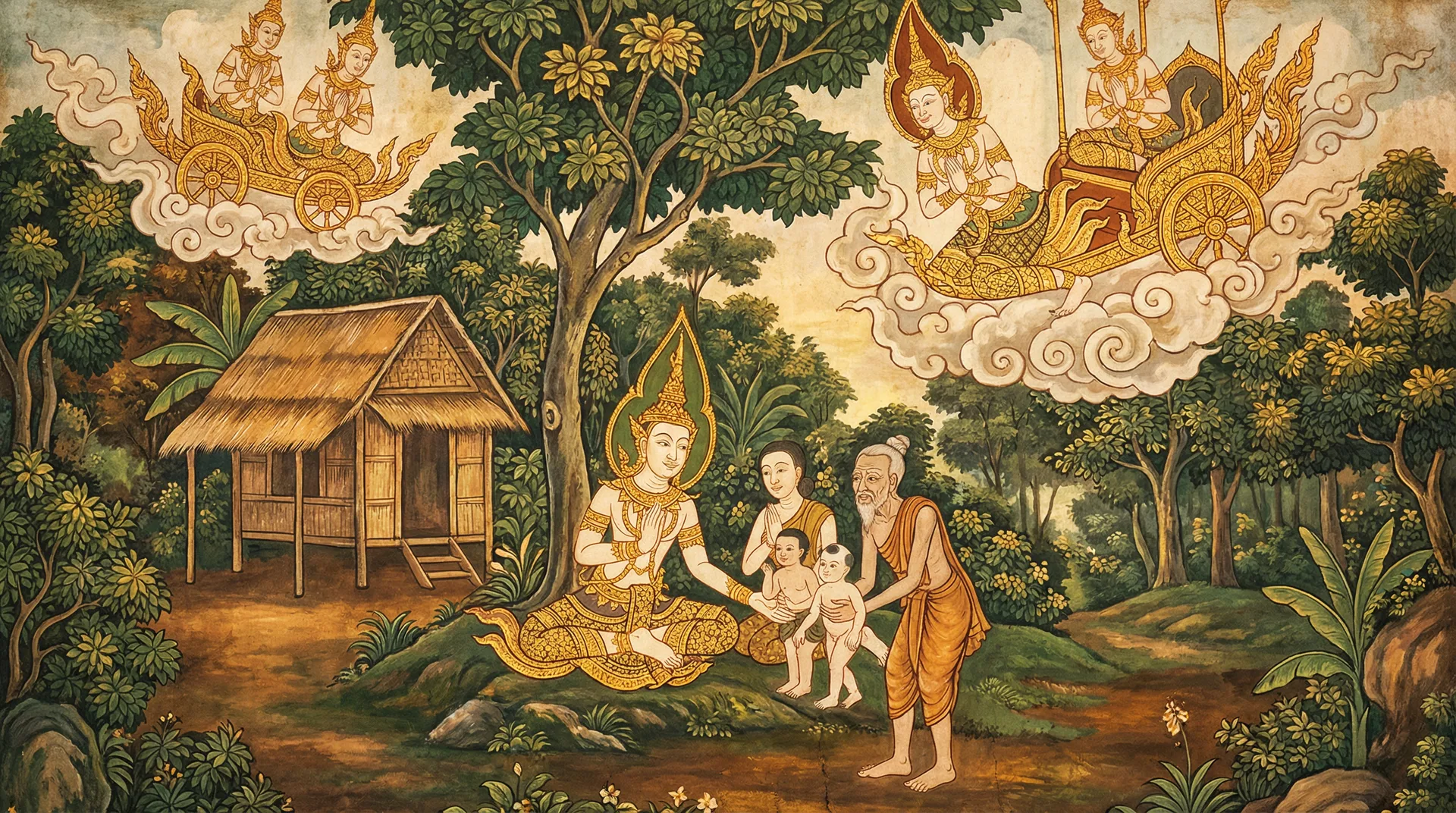
One evening, as the moon ascended, casting a silvery glow upon the forest, Sakka, the King of the Devas, decided to test the virtue of the beings on earth. He wished to see if any possessed the pure, selfless spirit that could truly exemplify the Dharma. Disguising himself as a poor, old Brahmin, Sakka descended from his heavenly abode and wandered into the forest where the four friends resided.
He approached the otter first, who was basking by the riverbank. "O Otter," said the disguised Sakka, his voice weak and trembling, "I am starving. I have traveled far and found no food. Do you have anything to offer me?"
The otter, seeing the Brahmin's apparent distress, felt a surge of sympathy. "Venerable sir," he replied, "I have only fish, which I catch from the river. But I fear they would not be suitable for your palate, nor would they truly satisfy your hunger." The otter, however, genuinely wanted to help. He offered the few fish he had managed to catch that day, but knew it was meager.
Next, Sakka approached the jackal, who was resting under a bush. "O Jackal," he called out, "I am a hungry traveler. Have you any food you could spare?"
The jackal, though cunning, also possessed a sense of empathy. "Brahmin," he said, "I have managed to find some remnants of a feast from a nearby village. It is not much, but please, take what I have." He offered the scraps of food, hoping it would offer some relief.
Then, Sakka met the monkey, who was merrily swinging through the trees. "O Monkey," the disguised deva implored, "my stomach aches with hunger. Can you offer me sustenance?"
The monkey, agile and quick, immediately began to gather fruits from the trees – ripe mangoes, sweet berries, and juicy figs. He piled them up at the base of the tree. "Here, venerable sir," the monkey said cheerfully, "take these fruits. They are fresh and sweet, and I hope they will nourish you."
Finally, Sakka reached the Bodhisattva hare, who was sitting peacefully beneath a tree, meditating on the impermanence of life. "O Hare," Sakka said, his voice laced with feigned desperation, "I am a poor Brahmin, weak with hunger. I have sought food everywhere, but found none. Is there anything you can give me?"
The Bodhisattva hare looked at the old Brahmin with eyes full of compassion. He knew that the monkey, the jackal, and the otter had already offered what little they had. He himself had only grass and leaves, which would be of no use to the Brahmin. He considered the situation deeply. Then, he looked up at the sky and said, "Venerable sir, I have nothing of material value to offer you. However, I have my own body. If my flesh will sustain you, please, take it."
The disguised Sakka was astonished by the hare's selfless offer. "But how can I possibly accept your body, O Hare? It is not a simple matter to prepare human flesh."
"Do not worry, Brahmin," the Bodhisattva hare replied calmly. "You need only build a fire. I will jump into it, and my body will be cooked, ready for you to eat."
The disguised Sakka, moved beyond words, built a small fire. The Bodhisattva hare, without a moment's hesitation, gathered his strength and leaped into the flames. He endured the burning pain with a serene mind, his thoughts focused only on the merit of his act and the well-being of the Brahmin.
As the hare's body lay in the fire, Sakka, the King of the Devas, could no longer maintain his disguise. The immense purity and selflessness of the Bodhisattva's sacrifice overwhelmed him. He revealed his true form, radiant and majestic, and gently lifted the hare's body from the flames. The fire had not harmed the Bodhisattva, for his virtue protected him.
Sakka then took a piece of the hare's body, and with his divine power, shaped it into a perfect image of the hare. He then placed this image in the sky, on the face of the moon, so that all beings could see it for eternity. This is why, to this day, we can see the image of a hare on the moon.
"Noble hare," Sakka declared, his voice echoing with divine approval, "your selfless sacrifice is a testament to the highest form of compassion and renunciation. You have shown the world the true meaning of giving. Your virtue will be remembered forever."
Sakka then restored the Bodhisattva hare to life, his body perfectly whole again. The hare bowed gratefully to the King of the Devas. The other animals, witnessing this incredible display of virtue, were deeply inspired. They understood that true generosity transcends all material possessions and that the greatest gift one can offer is oneself, freely and without expectation.
The Sasa Jataka became a profound teaching, a reminder that the path to enlightenment is paved with selfless giving and boundless compassion, and that the image of the hare on the moon forever symbolizes the ultimate sacrifice made for the benefit of all beings.
— In-Article Ad —
💡Moral of the Story
The greatest gift one can offer is oneself, given freely and with boundless compassion, for the benefit of all.
Perfection: Renunciation (Nekkhamma Paramita) and Compassion (Karuna Paramita)
— Ad Space (728x90) —
More Jataka Tales You May Enjoy
 451Dasakanipāta
Mahā-Ummagga Jātaka
The Great Tunnel Jātaka (Mahā-Ummagga Jātaka) In the ancient city of Mithila, ruled a wise and benev...
💡 True wisdom lies not only in skill but in understanding intentions and acting with righteousness. Deceit and envy ultimately lead to ruin, while integrity and foresight ensure security.
 418Aṭṭhakanipāta
Assaka Jataka
The Tale of the Valiant HorseIn the prosperous kingdom of Mithila, ruled a king known for his opulen...
💡 Courage and loyalty are more powerful than brute strength. A brave heart can overcome any obstacle.
 410Sattakanipāta
Cattari Puttajataka
Cattari Puttajataka In the prosperous kingdom of Kasi, ruled a wise and benevolent king named Brahma...
💡 True and lasting happiness is not found in the endless pursuit of material possessions, intellectual achievements, or even in the heavy burden of constant good deeds, but in the cultivation of inner contentment, appreciating the present moment, and finding joy in life's simple blessings.
 388Chakkanipāta
Samkicca Jataka
Samkicca JatakaIn the vibrant city of Savatthi, a place alive with the chatter of merchants and the ...
💡 Honesty and integrity are the most valuable treasures. Even when faced with deception and adversity, speaking the truth and maintaining one's principles will ultimately lead to vindication.
 538Mahānipāta
Kusa Jataka
The Tale of Prince Kusa and the Trials of Love In the magnificent city of Indapatta, ruled King Okka...
💡 True love is characterized by loyalty, commitment, and unwavering devotion. Infatuation is fleeting and can lead to great suffering, while true love endures through trials and tribulations.
421AṭṭhakanipātaMūgapakkha Jātaka
Mūgapakkha JātakaIn the heart of the Kosala kingdom, where golden fields stretched to the horizon an...
💡 True strength lies not in the ability to speak or exert force, but in the power of selfless compassion and unwavering sacrifice. Actions, especially those born of immense kindness, speak louder than words.
— Multiplex Ad —