
Nimi Jataka
Nimi Jataka
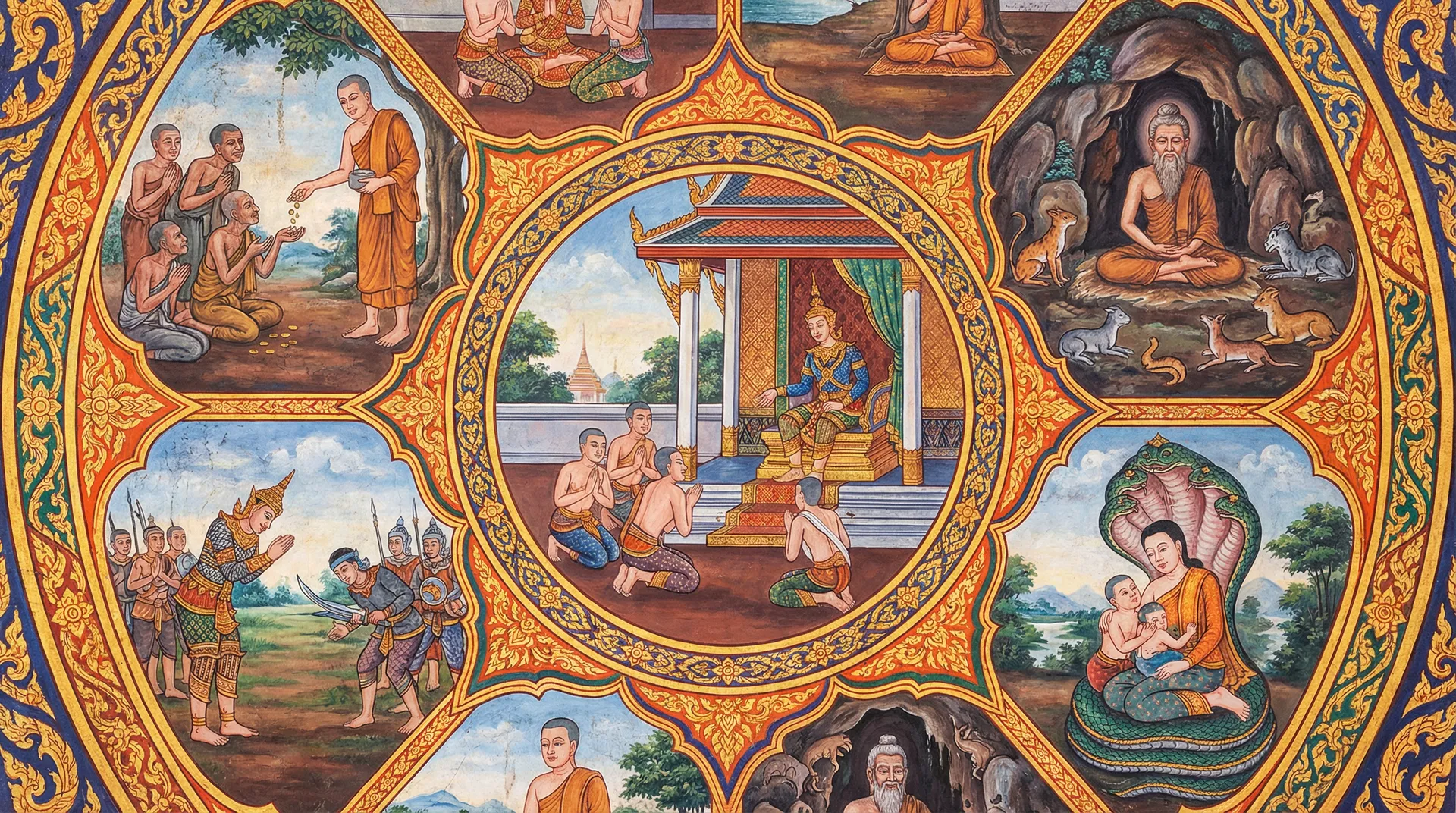
In the celestial realm, where clouds of spun gold drifted lazily across a sky of perpetual twilight, lived King Nimi. He was a monarch of great virtue, his reign a beacon of justice and compassion in the mortal world below. Yet, even a king as righteous as Nimi yearned for a glimpse of the divine, a taste of the pleasures that awaited the truly virtuous in the heavens.
One day, as Nimi sat on his throne, contemplating the impermanence of earthly glory, a celestial chariot, shimmering with an ethereal light, descended from the heavens. At its reins stood Sakka, the King of Gods, his form radiating benevolence. 'O King Nimi,' Sakka's voice resonated like the chime of a thousand bells, 'your virtue has not gone unnoticed. I have come to invite you to the Tavatimsa heaven, to witness the celestial festivities and partake in the joys of the gods.'
Nimi, though overjoyed, was also a man of deep wisdom. He knew that such an invitation was not merely for indulgence but for learning. 'Great Sakka,' he replied, bowing his head with respect, 'I would be honored to accept your invitation. But tell me, what are the duties and joys of the gods? What are the true measures of their bliss?'
Sakka smiled, his eyes twinkling like distant stars. 'Come, Nimi, and see for yourself. The heavens are a testament to the fruits of merit. Here, beings live in perpetual happiness, their lives filled with music, dance, and the contemplation of Dharma.'
Thus, King Nimi ascended to the Tavatimsa heaven in Sakka's chariot. As he stepped onto the celestial grounds, he was awestruck. The palaces were built of pure crystal, the gardens bloomed with flowers that sang melodies, and the air was filled with the sweet scent of celestial incense. He witnessed the gods and goddesses engaged in joyous activities, their laughter echoing through the heavens.
Sakka guided Nimi through the celestial realms, explaining the cause of their bliss. 'Each of these heavenly beings,' Sakka explained, 'has accumulated immense merit in their past lives through acts of generosity, adherence to the precepts, and the cultivation of wisdom. Their current state is a direct result of their past deeds.'
Nimi spent his time observing, listening, and learning. He saw how the gods, despite their immense pleasures, still engaged in acts of kindness and compassion. He witnessed their unwavering adherence to the principles of righteousness. He noticed that their bliss was not merely a passive state but an active engagement with virtue.
One day, Nimi was granted an audience with the celestial sculptor, Vishwakarma. The sculptor was meticulously crafting a divine chariot, its parts gleaming with intricate designs. 'O noble sculptor,' Nimi inquired, 'what is the purpose of this magnificent chariot?'
'This chariot, O King,' Vishwakarma replied, 'is not for transportation. It is a symbol of the path to enlightenment. Each part represents a virtue, and the whole signifies the journey of a Bodhisattva. It reminds us that even in heaven, the pursuit of perfection continues.'
Nimi's heart swelled with understanding. He realized that true bliss was not just about enjoying the fruits of past merit but about continuing to cultivate merit in the present. He saw that the gods, in their heavenly abode, were not idle but were constantly engaged in practices that further purified their minds and enhanced their compassion.
After a period of profound learning, Sakka offered Nimi a boon. 'Ask for anything, O King,' he said. 'Your virtue has earned you this privilege.'
Nimi, with a serene smile, replied, 'Great Sakka, I wish for nothing more than to return to my kingdom and share the wisdom I have gained. I wish to inspire my people to live lives of virtue, to understand that true happiness lies not in fleeting pleasures but in the cultivation of a pure heart and the practice of righteousness. I wish to be reborn in a time when the Dhamma is fully flourishing, so that I may further deepen my understanding and contribute to its spread.'
Sakka, impressed by Nimi's selfless wish, granted it with pleasure. He bid farewell to King Nimi, who returned to his earthly kingdom, his heart filled with a newfound purpose. He ruled with even greater wisdom and compassion, his teachings echoing the celestial lessons he had learned. He dedicated the rest of his days to spreading the Dhamma, inspiring countless beings to walk the path of virtue, knowing that the true heavens are not just in the stars, but within the hearts of those who cultivate goodness.
— In-Article Ad —
💡Moral of the Story
True bliss is found not just in the enjoyment of past merits, but in the continuous cultivation of virtue and wisdom in the present moment.
Perfection: Wisdom (Prajna)
— Ad Space (728x90) —
More Jataka Tales You May Enjoy
 261Tikanipāta
Nimi Jataka
Nimi JatakaIn the glorious city of Mithila, ruled the wise King Nimi. His reign was a beacon of righ...
💡 Even the most glorious heavenly realms are impermanent. True and lasting happiness is found in the liberation from suffering through the attainment of Nirvana, which requires inward cultivation of wisdom and detachment.
259TikanipātaMūgapakkha Jātaka
Mūgapakkha JātakaIn the bustling city of Ujjeni, a hub of commerce and culture, resided King Candapa...
💡 True greatness is found not in worldly fame or ambition, but in inner peace, profound wisdom, and a deep connection to life.
 141Ekanipāta
Mugapakkha Jataka
The Tale of the Mute Prince In the ancient kingdom of Mithila, ruled a just king named Dhanañjaya. H...
💡 True leadership is demonstrated through actions, courage, and compassion, not merely through eloquent speech.
 352Pañcakanipāta
Kusa Jataka
Kusa Jataka Long, long ago, in the ancient kingdom of Mithila, there lived a prince named Kusa. He w...
💡 True love and unwavering resolve can overcome great obstacles, and wisdom is often gained through hardship and self-reflection.
97EkanipātaThe Tale of the Ancient Swan
In the city of Savatthi, while the Buddha resided at the Jetavana Monastery, he recounted a past lif...
💡 True nobility resides in the heart and character, not in status or possessions. Forgiveness and inner peace are more valuable than any worldly gain.
117EkanipātaKakara Jataka
Kakara Jataka In a verdant forest, where sunlight dappled through the thick canopy and streams sang ...
💡 Unity, courage, and wise leadership are essential to overcome adversity. Facing challenges with a clear mind and a united front, rather than succumbing to fear, leads to survival and prosperity.
— Multiplex Ad —