
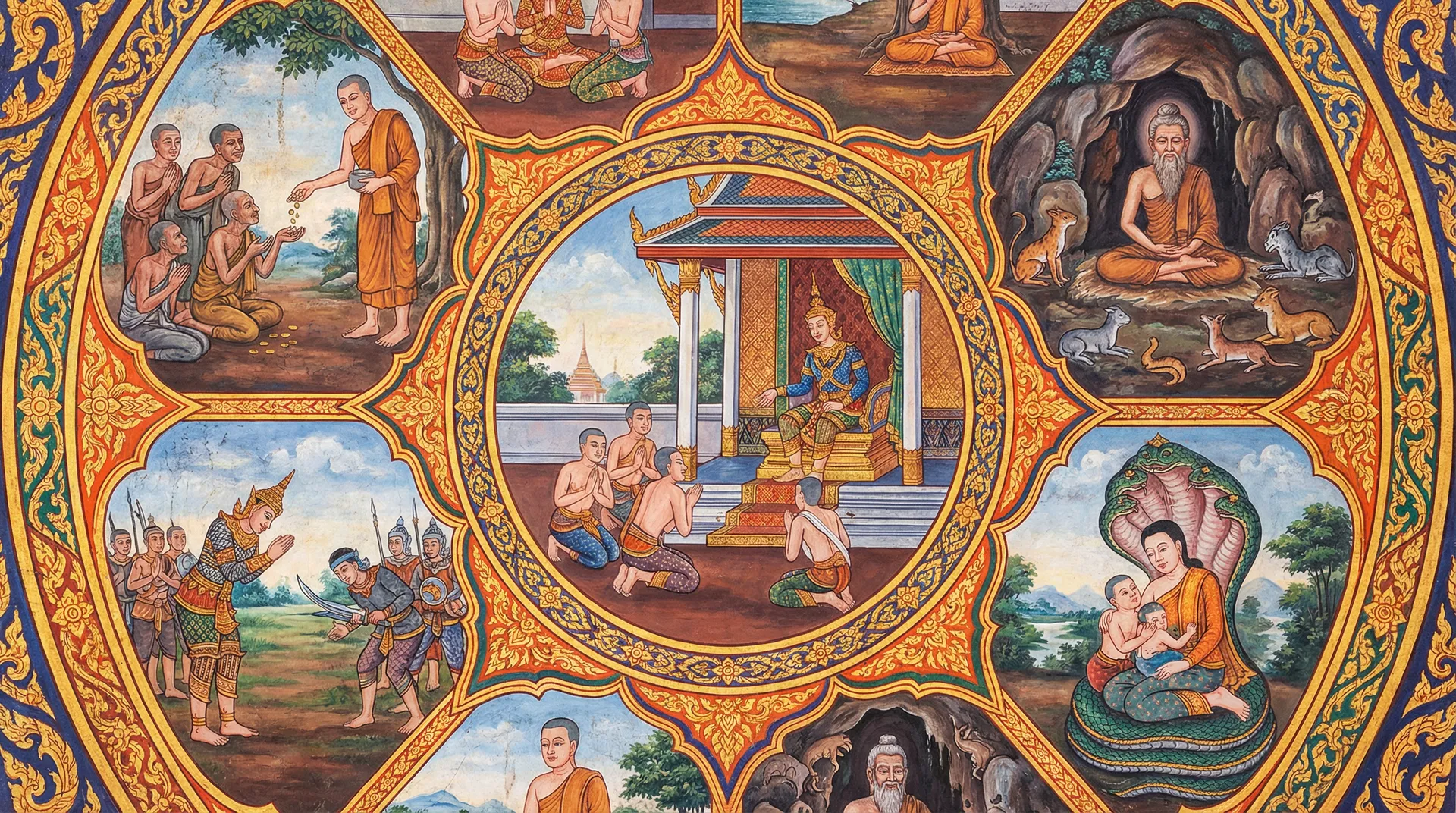
Phra Ong Thammachak (The Bodhisatta as a Sage Who Established Justice)
Phra Ong Thammachak (The Bodhisatta as a Sage Who Established Justice)
In the ancient land of Gandhara, a kingdom once blessed with peace and prosperity, a dark cloud of injustice had begun to spread. The king, though not inherently wicked, had become swayed by the whispers of greedy courtiers and the allure of personal comfort. He neglected his duties, and his laws, once a beacon of fairness, became twisted and biased, favoring the rich and powerful while oppressing the common folk.
The people suffered. Their pleas for redress fell on deaf ears, their livelihoods were threatened by unjust taxes, and fear began to replace the former harmony. It was in this time of deep despair that a wise sage, the Bodhisatta, appeared. He was a man of profound knowledge, his mind a repository of wisdom, and his heart a wellspring of compassion for all beings.
The Bodhisatta, seeing the suffering of the people and the decay of justice, knew he had to act. He did not possess the power of a king, nor the might of an army, but he possessed something far more potent: the unwavering power of truth and the irrefutable logic of righteousness.
He journeyed to the capital city and, with quiet dignity, presented himself at the royal court. The king, surrounded by his sycophantic advisors, initially dismissed the sage as a mere mendicant. But the Bodhisatta, with a voice as clear and resonant as a temple bell, spoke words that cut through the gilded lies and self-serving arguments of the courtiers.
"Your Majesty," the Bodhisatta began, his gaze steady and unwavering, "you rule a kingdom whose strength lies not in its armies, but in the hearts of its people. Yet, I see those hearts heavy with sorrow, their spirits crushed under the weight of unfair laws. A kingdom that neglects justice is like a body that neglects its health; it will inevitably decay and fall." The courtiers scoffed, attempting to dismiss his words. But the Bodhisatta, undeterred, continued to present his case, using parables and logical reasoning to expose the flaws in the king's current governance.
He spoke of a farmer who tried to harvest crops from barren land, illustrating how the king's unjust laws yielded no true prosperity. He spoke of a river that flowed backward, symbolizing the unnatural and destructive course the kingdom was taking. He explained that true leadership was not about accumulating personal wealth or power, but about ensuring that every citizen, from the humblest peasant to the noblest lord, was treated with fairness and equity.
The king, initially resistant, found himself captivated by the sage's wisdom. The clarity of his arguments, the undeniable truth in his words, began to chip away at the king's complacency. He realized that the sage was not an enemy, but a messenger of truth, a reflection of the suffering he had been ignoring.
The Bodhisatta then proposed a radical, yet simple, solution: the establishment of a "Wheel of Dharma" for justice. He explained that this wheel represented the path of righteousness, where laws were not arbitrary decrees, but principles guided by wisdom, compassion, and truth. He outlined a system where disputes would be settled based on evidence and fairness, where the voice of the oppressed would be heard, and where justice would be accessible to all, regardless of their status.
He proposed the creation of impartial councils, the simplification of legal procedures, and the consistent application of laws without favor or prejudice. He emphasized that the king himself must be the first to uphold these principles, leading by example.
The king, deeply moved and enlightened, embraced the Bodhisatta's teachings. He dismissed the corrupt courtiers and appointed men of integrity to advise him. He then, with the Bodhisatta's guidance, began to reform his kingdom, establishing a system of governance that truly reflected the "Wheel of Dharma" – a perfect cycle of justice, fairness, and compassion.
Under the new regime, Gandhara transformed. The people, no longer oppressed, flourished. Their trust in the monarchy was restored, and the kingdom entered a golden age of peace and prosperity, its reputation for justice spreading far and wide.
The Bodhisatta, having set the Wheel of Dharma in motion, quietly departed, knowing that true justice, once established, could sustain itself. His legacy was not one of conquest or personal glory, but of establishing an enduring system of righteousness that benefited all beings, a testament to the profound power of wisdom and compassion in shaping a just and harmonious society.
— In-Article Ad —
💡Moral of the Story
True justice is the foundation of a prosperous and harmonious society. Leadership must be guided by wisdom, compassion, and truth, ensuring fairness and equity for all.
Perfection: Wisdom (Panna) and Truthfulness (Sacca)
— Ad Space (728x90) —
More Jataka Tales You May Enjoy
169DukanipātaDhammapāla Jātaka
Dhammapāla JātakaIn a land of rolling hills and verdant valleys, where the air was often perfumed wi...
💡 Integrity and truth, when faced with malice and deception, should be met with patience and steadfastness rather than retaliation. True virtue will eventually be recognized.
 370Pañcakanipāta
MUGA-PAKKA JATAKA
MUGA-PAKKA JATAKAIn the heart of a vast jungle, where ancient trees stood like silent sentinels and ...
💡 True strength lies not in aggression or domination, but in courage, justice, and the protection of the vulnerable. Compassion and wisdom are more powerful than brute force, and even enemies can be overcome through righteousness.
193DukanipātaSarbhangajataka
Sarbhangajataka In the venerable city of Varanasi, where the Ganges flowed like a silken ribbon and ...
💡 Truth and virtue, when deeply rooted, cannot be destroyed by falsehood or malice. Those who spread lies and sow discord ultimately reveal their own corrupt nature.
191DukanipātaKaccapajataka
Kaccapajataka In the ancient kingdom of Mithila, where palaces shimmered like lotus blossoms and riv...
💡 True wealth lies not in what we possess, but in our ability to be content with what we have. Greed is a bottomless pit that can never be filled.
 144Ekanipāta
Maca Hamsa Jataka
The Tale of the Golden Swan King In the realm of the Himalayas, amidst snow-capped peaks and crystal...
💡 True wealth lies in inner virtue, wisdom, and compassion, not in material possessions which are transient.
179DukanipātaMahāpuṇṇa Jātaka
Mahāpuṇṇa JātakaIn the heart of the kingdom of Kasi, a land blessed with fertile soil and a prospero...
💡 By consciously pausing and reflecting when anger arises, one can gain control over impulsive reactions, leading to wiser decisions, improved relationships, and inner peace. Cultivating patience and understanding is a path to great merit.
— Multiplex Ad —