
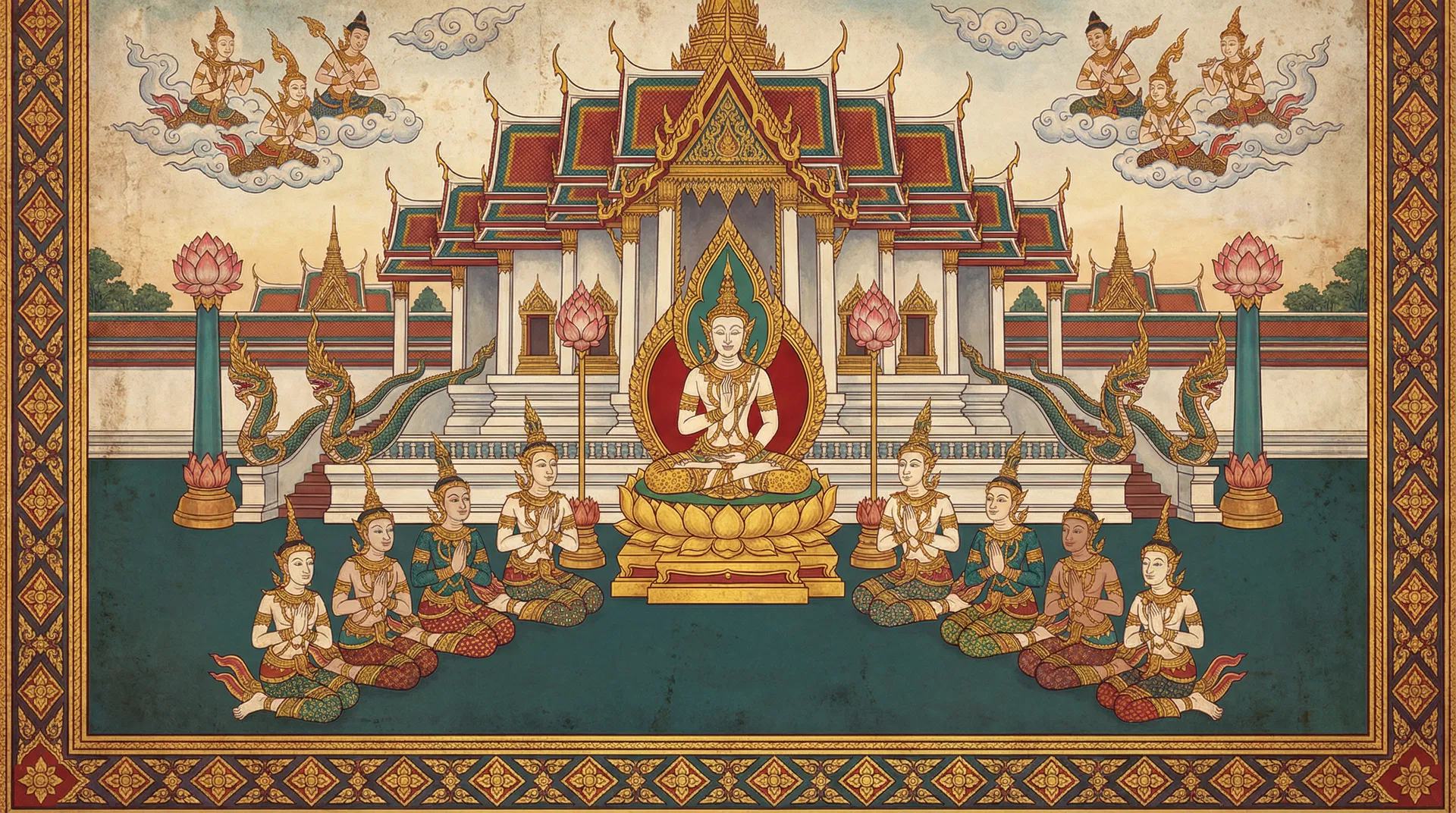
Phra Ong Khon Duang Chan (The Bodhisatta as a Celestial Being Who Manifested as a Moonbeam)
Phra Ong Khon Duang Chan (The Bodhisatta as a Celestial Being Who Manifested as a Moonbeam)
High above the earthly realm, in the celestial abode of the gods, resided the Bodhisatta, a being of immense compassion and boundless merit. He gazed down upon the world, his heart aching at the suffering he witnessed. In particular, his attention was drawn to a small village nestled beside a dense, dark forest, where a terrible drought had gripped the land for months. The earth was parched, the rivers had dwindled to mere trickles, and the people, gaunt and despairing, prayed for relief.
Among the villagers was a young woman, the embodiment of kindness and resilience. Her name was Sirima, and though her own family suffered from thirst and hunger, she always shared her meager portions with those even less fortunate. Her compassion was a small flame in the encroaching darkness of despair.
The Bodhisatta, moved by Sirima's selfless love and the collective suffering of the villagers, decided to descend to the mortal plane. However, he did not wish to appear in a grand, ostentatious manner that might frighten or overwhelm the desperate people. Instead, he chose to manifest in a form that was gentle, nurturing, and intimately connected to the cycle of life – he became a moonbeam.
As the moon ascended its nightly throne, a single, ethereal moonbeam, imbued with the Bodhisatta's compassionate energy, descended from the heavens. It was not a harsh, blinding light, but a soft, silvery glow that seemed to whisper promises of hope. This special moonbeam landed gently upon the parched earth, right beside Sirima as she sat outside her humble dwelling, her eyes filled with sorrow as she looked at the barren fields.
The moonbeam, invisible to most, seemed to emanate a soothing warmth. Sirima, though she could not see its divine origin, felt a strange sense of peace wash over her. As the moonbeam touched the dry soil, a miracle began to unfold. Tiny, dew-like droplets began to form, not evaporating in the night air, but coalescing, growing, and gathering. It was as if the moonbeam itself was weeping tears of compassion, transforming into pure, life-giving water.
Throughout the night, the moonbeam continued its gentle work. The droplets grew into a small pool, then a stream, and finally, by the time the first rays of dawn touched the horizon, a small, clear spring had bubbled forth from the earth. The water was cool, pure, and abundant, a gift from the heavens.
When the villagers awoke, they were met with the astonishing sight of fresh, flowing water. Their cries of despair turned into shouts of joy and gratitude. They rushed to the spring, drinking deeply, their faces filled with wonder. Sirima, seeing the relief and happiness of her community, felt her heart swell with a joy that rivaled the celestial bliss of the gods.
The king of the land, upon hearing of the miraculous spring, sent his emissaries to investigate. They returned with tales of the pure water and the profound sense of peace that permeated the area. The king, a wise ruler, understood that such a miracle was no mere natural occurrence. He declared a day of thanksgiving, and the village, once a place of suffering, became a sanctuary of hope, its spring a constant reminder of divine compassion.
The Bodhisatta, having fulfilled his compassionate intention, returned to his celestial abode, his heart content. He had shown that even the most subtle and gentle of forces, guided by pure compassion, could bring forth immense relief and transform despair into hope. The moonbeam, though ephemeral, had left an everlasting mark on the land and the hearts of its people.
The story of the moonbeam that brought forth life became a cherished legend, passed down through generations. It taught that even in the darkest of times, when all hope seems lost, a single act of pure compassion, or a divine intervention, can bring forth the waters of renewal, nurturing life and bringing solace to a suffering world.
— In-Article Ad —
💡Moral of the Story
Compassion, even in its most subtle forms, has the power to bring forth life and renewal, transforming despair into hope and offering solace to those in need.
Perfection: Compassion (Karuna) and Generosity (Dana)
— Ad Space (728x90) —
More Jataka Tales You May Enjoy
248DukanipātaKatthahari Jataka
Katthahari JatakaIn the bustling city of Savatthi, there lived a woodcutter named Katthahari. He was...
💡 Selfless compassion, even towards the smallest creatures and when faced with personal temptation, is a virtue that brings great rewards and blessings.
 429Navakanipāta
Asadisa Jataka
The Tale of the Unrivaled Gift In the magnificent city of Savatthi, there lived a king named Suppara...
💡 True generosity is selfless and unconditional. It is given without expectation of reward, without seeking praise, and without any thought of the giver's own comfort. Such giving nourishes both the recipient and the giver, bringing peace and contentment.
 150Ekanipāta
Mahapada Jataka
Mahapada JatakaIn the ancient and prosperous city of Varanasi, there reigned a king named Bodhisatta...
💡 The greatest gift a ruler can give to their people is the teaching of righteousness and virtue (Dhamma), which leads to inner peace, wisdom, and lasting happiness.
178DukanipātaMūgapakkha Jātaka
Mūgapakkha JātakaIn the bustling city of Varanasi, renowned for its vibrant arts and thriving commer...
💡 True wisdom is not always expressed through eloquent words. Deep observation, keen discernment, and insightful actions can reveal truths that speech may conceal. Silence can be a powerful medium for conveying profound understanding.
103EkanipātaMora Jātaka
The Golden Peacock's Plea In the heart of a vast and ancient forest, where emerald canopies kissed t...
💡 True beauty and value are best appreciated in their natural state. Possessing something or someone against their will diminishes its essence and leads to suffering, both for the captive and the captor. Freedom and dignity are paramount.
119EkanipātaMasa Jataka
Masa Jataka In a sprawling forest, where ancient trees reached towards the heavens and a thousand st...
💡 Patience, resilience, and unwavering leadership are crucial to overcome extreme hardship. Selfless compassion and the prioritization of the vulnerable are the hallmarks of true strength and lead to collective survival.
— Multiplex Ad —