
Mahosadha Jataka
Mahosadha Jataka
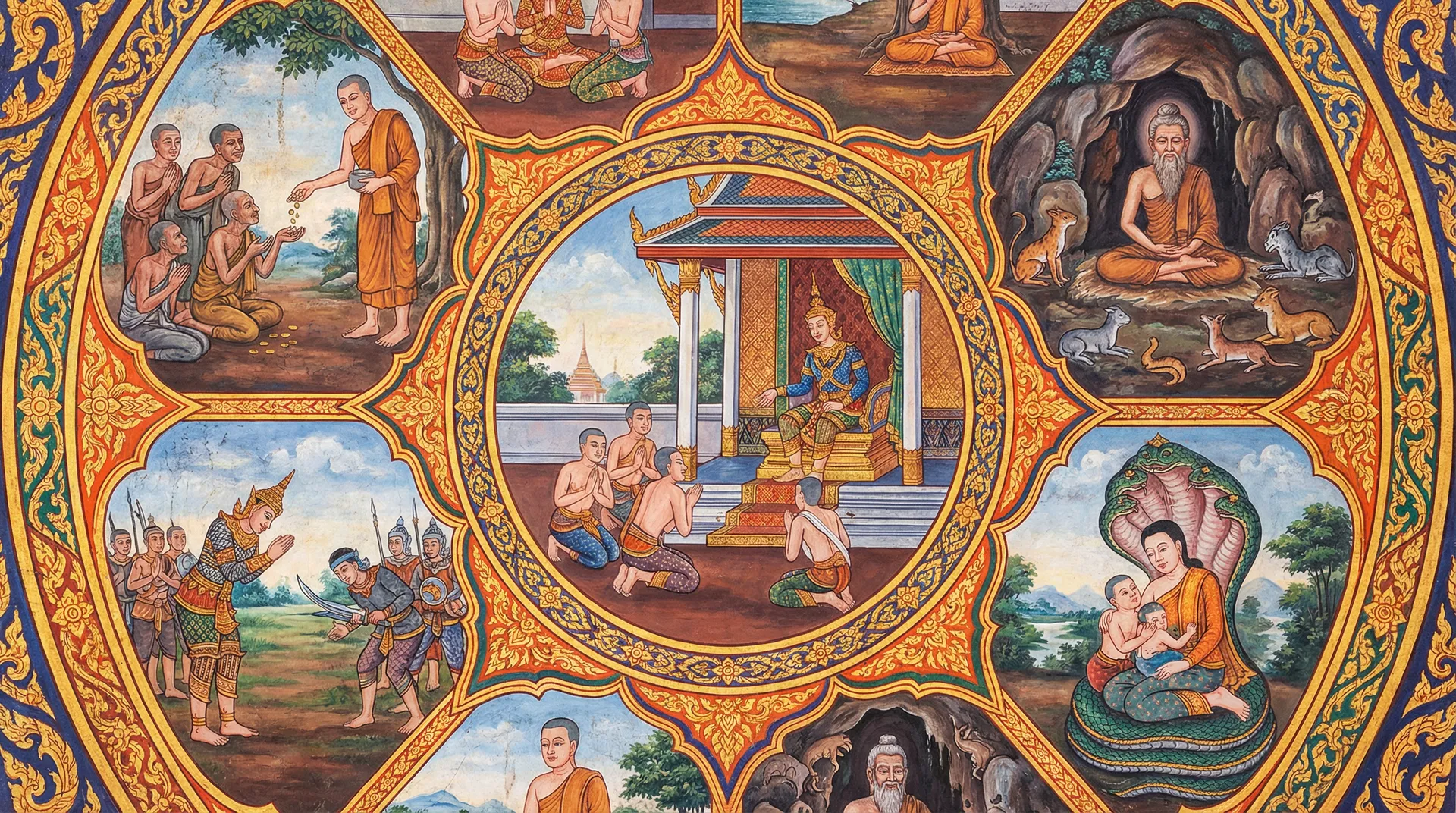
In the prosperous kingdom of Mithila, nestled amidst fertile plains and bordered by shimmering rivers, lived a prince named Vidudabha. Though born to royal lineage, his heart was often troubled by indecision and a lack of profound wisdom. He relied heavily on his ministers, yet none possessed the sharp intellect and unwavering judgment that the kingdom truly needed.
It was during this time that a young man of extraordinary intellect, known as Mahosadha, rose to prominence. Mahosadha was not born into royalty, nor was he a learned scholar from a famed academy. His wisdom sprang from an innate understanding of the world, a keen observation of human nature, and an unparalleled ability to solve complex problems with simple, elegant solutions. His reputation as a prodigy spread throughout the land, and eventually, he was summoned to the royal court.
Prince Vidudabha, initially skeptical of this commoner's famed intellect, put Mahosadha to the test. A series of intricate challenges were presented: a barren field that needed to yield crops overnight, a herd of cows that mysteriously produced no milk, and a dispute between two merchants over a seemingly worthless piece of pottery.
Mahosadha, with his characteristic calm and clarity, tackled each problem. For the barren field, he devised a clever irrigation system using dew collected overnight, proving that even the most barren land could be productive with ingenuity. For the milkless cows, he observed that they were being fed an unusual herb, which, when removed, restored their milk production. And for the pottery dispute, he cleverly revealed that the merchants were attempting to pass off a fake as an ancient artifact, thereby uncovering the deception.
Impressed beyond measure, Prince Vidudabha appointed Mahosadha as his chief advisor, a position he filled with unparalleled dedication and skill. Mahosadha's counsel was always guided by righteousness, foresight, and a deep understanding of justice. He navigated the complexities of court politics with grace, always prioritizing the welfare of the people and the stability of the kingdom.
One of the most significant challenges Mahosadha faced was a looming conflict with a neighboring kingdom, ruled by a belligerent king named Aggika. Aggika, fueled by pride and ambition, sought to provoke a war, sending arrogant envoys with insulting demands. The court was divided: some advocated for immediate retaliation, while others urged for appeasement.
Mahosadha, however, saw a different path. He understood that true strength lay not in brute force, but in wisdom and diplomacy. He advised Prince Vidudabha to respond not with aggression, but with a display of profound generosity and understanding. He proposed sending a gift to King Aggika – not weapons or treasures, but a collection of the finest medical herbs and treatises on healing, along with a message expressing concern for the king's well-being and offering assistance should he or his people be afflicted by illness.
The advisors scoffed. "This is weakness!" they cried. "He will see it as an invitation to attack!"
But Mahosadha remained steadfast. "True strength," he explained, "lies in the ability to disarm an enemy not with force, but with kindness. If King Aggika is truly as belligerent as he seems, his actions stem from insecurity or perhaps illness. By offering healing, we address the root cause of his aggression, not just the symptom. We show him that our kingdom is one of peace and compassion, not conquest."
Prince Vidudabha, trusting Mahosadha's counsel, followed his advice. The gifts were sent, along with a delegation of skilled physicians. King Aggika was taken aback. He had prepared for war, for defiance, for a show of power. Instead, he received an offering of healing and concern.
The gesture had a profound effect on Aggika. He was not a cruel man, merely a proud and perhaps misguided one. The unexpected kindness disarmed him completely. He realized that his perceived slights were not met with the hostility he expected, but with a magnanimity that humbled him. He began to question his own motives and the righteousness of his aggressive stance.
When the physicians offered their services, Aggika confessed that he had been suffering from a persistent ailment that had plagued him for months, making him irritable and prone to rash decisions. The physicians, with their knowledge and the gifted herbs, were able to provide relief. As his health improved, so did his disposition.
King Aggika sent back his own delegation, not with demands, but with apologies and expressions of gratitude. He declared an end to his aggressive posturing and proposed a pact of friendship and mutual cooperation with Mithila. The kingdom was saved from the ravages of war, not by the clash of swords, but by the quiet power of wisdom and compassion.
Mahosadha continued to serve Mithila faithfully, his wisdom illuminating the path for Prince Vidudabha and ensuring peace and prosperity for the kingdom. He demonstrated that true leadership is not about wielding power, but about using intellect and compassion to foster understanding and well-being. His life became a testament to the principle that the greatest victories are often won not on the battlefield, but in the realm of the mind and heart.
— In-Article Ad —
💡Moral of the Story
Wisdom, foresight, and compassion are more powerful than aggression. Addressing the root causes of conflict with understanding and kindness can lead to lasting peace.
Perfection: Wisdom (Panna) and Truthfulness (Sacca)
— Ad Space (728x90) —
More Jataka Tales You May Enjoy
 357Pañcakanipāta
Sattubhatta Jataka
Sattubhatta Jataka Long ago, in a time when gods and humans walked more closely, the great Bodhisatt...
💡 True wealth is not measured by possessions, but by generosity and the well-being of others. Greed leads to emptiness, while sharing brings true satisfaction and prosperity.
 131Ekanipāta
Mugapakkha Jataka
The Tale of the Mute Prince In the ancient kingdom of Varanasi, nestled beside the sacred Ganges, li...
💡 True wisdom often lies not in speaking, but in knowing when and how to speak, especially when words are needed to uphold truth and compassion.
145EkanipātaMahosadha Jataka
The Tale of Mahosadha, the Wisest of All In the ancient city of Mithila, under the reign of King Ved...
💡 Profound wisdom, applied with compassion and foresight, can bring peace, prosperity, and justice to a kingdom and its people.
116EkanipātaDhammapala Jataka
Dhammapala Jataka In the ancient city of Varanasi, nestled beside the sacred Ganges, lived a king re...
💡 True treasures are not material possessions, but wisdom, compassion, and the restraint shown in the face of temptation. Unchecked greed leads to destruction, while true leadership is characterized by foresight and the well-being of others.
124EkanipātaSutasoma Jataka
Sutasoma Jataka In the glorious city of Indapatta, there reigned a king named Pindola, a monarch of ...
💡 True victory is achieved not through violence or force, but through the unwavering power of truth, compassion, and understanding, which can transform even the darkest of hearts.
 275Tikanipāta
Kusa Jataka
Kusa JatakaIn the opulent city of Varanasi, amidst a kingdom blessed with abundance, lived a king re...
💡 True wealth lies not in material possessions or worldly power, but in inner contentment, detachment, and wisdom, which bring lasting peace and freedom from suffering.
— Multiplex Ad —