
Sutasoma Jātaka
The Tale of the Bodhisattva as a Pacifist King
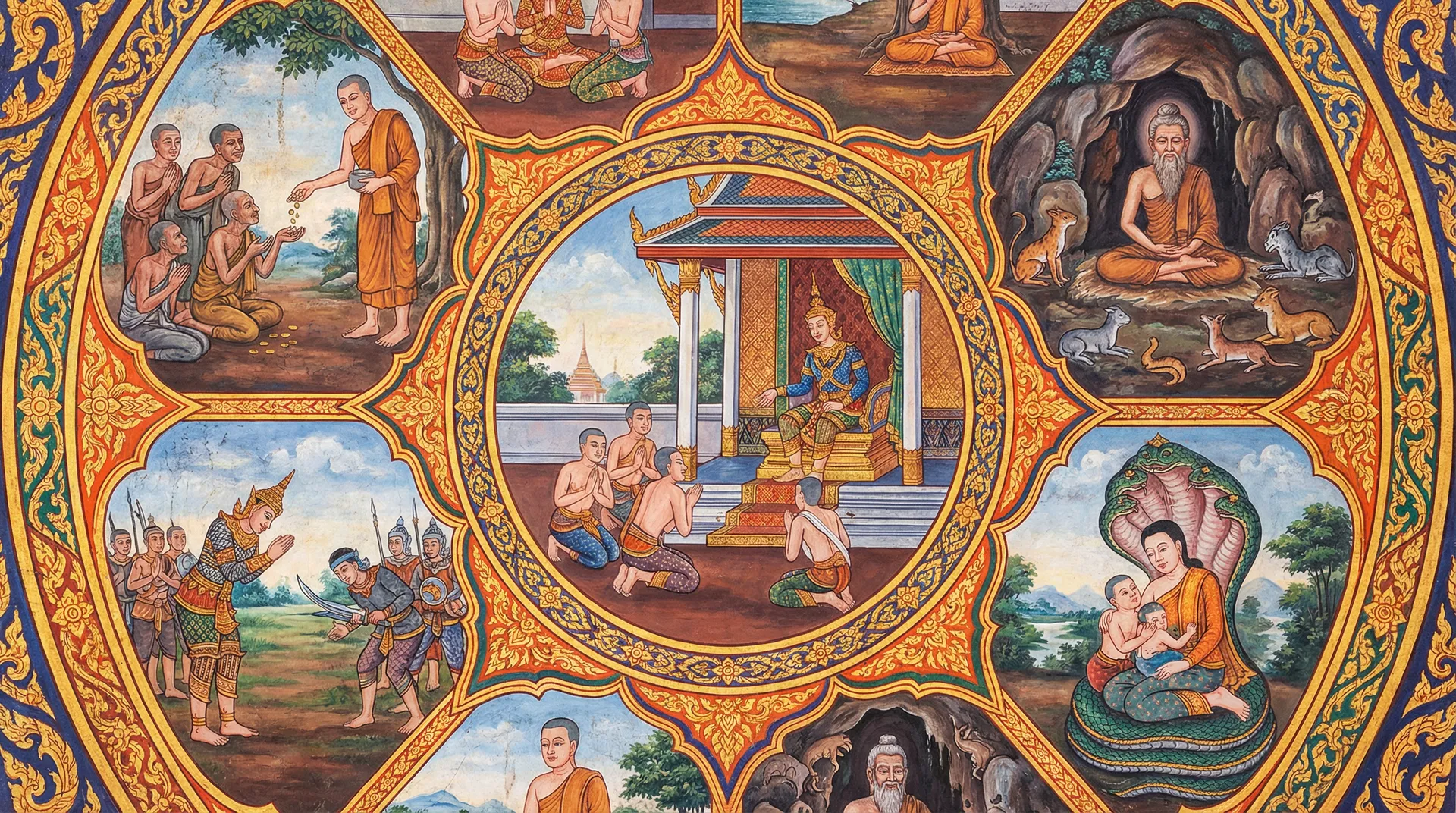
In the ancient city of Suvarna, there reigned a king named Sutasoma. He was a just ruler, beloved by his people, and known for his unwavering commitment to non-violence. This commitment was not born of weakness, but of a deep, philosophical understanding that violence begets more violence, and that true strength lies in restraint and compassion.
One day, a neighboring kingdom, ruled by a belligerent and power-hungry king named Virudhaka, decided to wage war. Virudhaka, coveting Suvarna's prosperity and resources, amassed a formidable army and marched towards its borders, his heart filled with lust for conquest.
News of the approaching invasion reached King Sutasoma. His ministers, fearful for their lives and their kingdom, urged him to raise an army, to prepare for battle, and to defend their home with force. "Your Majesty," they pleaded, "Virudhaka is a ruthless warrior. If we do not fight, he will surely destroy us all!"
King Sutasoma listened patiently to their pleas. He understood their fear, but his own principles were unshakeable. He replied, "My loyal subjects, I understand your concerns. However, to meet violence with violence is to perpetuate a cycle that will only bring more suffering. My path is one of peace. I will not raise an army to shed blood."
The ministers were aghast. Some whispered of treason, while others despaired. How could a kingdom survive without defending itself?
Undeterred, King Sutasoma devised a different plan. He ordered his royal chefs to prepare a magnificent feast, the likes of which had never been seen before. He commanded that the finest delicacies, the most fragrant fruits, and the sweetest beverages be gathered. He then sent a royal envoy to King Virudhaka, not with a declaration of war or a threat, but with an invitation.
The envoy, carrying a scroll and a basket of the finest fruits, approached the invading army. He presented the scroll to King Virudhaka, which read: "O King Virudhaka, I welcome you to my kingdom. I understand you seek a confrontation. However, I believe that true victory is not achieved through bloodshed, but through understanding and the nourishment of the spirit. I invite you and your commanders to a royal feast where we may discuss your grievances and find a peaceful resolution. Until then, please accept these fruits as a token of my goodwill."
King Virudhaka was utterly bewildered. He had expected resistance, a fierce battle, perhaps even the capture of a king. But an invitation to a feast? He scoffed, thinking it was a trick or a sign of cowardice. His commanders were equally perplexed.
However, Virudhaka, though warlike, was also known for his gluttony and his appreciation for fine food. The description of the feast and the exquisite fruits piqued his curiosity. After much deliberation and persuasion from his more pragmatic advisors who saw no immediate threat in a feast, he reluctantly agreed to the invitation, ordering his army to halt their advance and camp outside the city.
King Sutasoma received Virudhaka and his commanders with great hospitality. The feast was indeed grand, and the conversation, to Virudhaka's surprise, was not about surrender or weakness, but about the prosperity of both kingdoms, the common challenges they faced, and the shared desire for peace and well-being.
As they dined, King Sutasoma spoke calmly about the futility of war, the pain it caused to countless families, and the resources it wasted that could be used for the betterment of all. He spoke not with judgment, but with empathy and understanding. He shared his vision of a world where disputes were settled through dialogue and mutual respect.
King Virudhaka, initially arrogant and belligerent, found himself disarmed by Sutasoma's gentle demeanor, his profound wisdom, and the sheer sincerity of his peaceful approach. He had never encountered a ruler who valued peace so highly, who offered hospitality instead of hostility.
By the end of the feast, Virudhaka's heart began to soften. He saw that Sutasoma's strength was not in his army, but in his unyielding conviction and his profound compassion. He realized that conquering Suvarna would bring him no true glory, only more bloodshed and misery.
The next morning, King Virudhaka, to the astonishment of his own army, ordered a full retreat. He returned to his kingdom, not with spoils of war, but with a newfound respect for King Sutasoma and a seed of peace planted in his own heart. He understood that sometimes, the greatest victory is achieved not on the battlefield, but at the table, through the power of peace and understanding.
— In-Article Ad —
💡Moral of the Story
True strength lies in non-violence, restraint, and compassion. Conflicts can often be resolved through dialogue, understanding, and sincere efforts towards peace, rather than through aggression.
Perfection: Patience (Khanti Paramita)
— Ad Space (728x90) —
More Jataka Tales You May Enjoy
 358Pañcakanipāta
Kaka Jataka
Kaka Jataka In the realm of Mithila, where kings were known for their wisdom and the land was blesse...
💡 Greed for material possessions leads to discord, weakness, and destruction. True value lies in community, shared resources, and practical sustenance, which ensure survival and harmony.
 49Ekanipāta
The Bodhisatta as the Bodhi Tree
The Bodhisatta as the Bodhi TreeIn a tranquil corner of the great forest, where the air was thick wi...
💡 True patience and generosity are unwavering, offering sanctuary and life, and inspire others to choose compassion over destruction.
110EkanipātaMora Jataka
The Tale of the King, the Queen, and the Golden Peacock In the prosperous kingdom of Varanasi, nestl...
💡 True beauty lies not in outward appearance but in inner virtues like wisdom, compassion, and kindness. Superficial fascination can blind us to the enduring value of character.
 254Tikanipāta
Mātu-posaka-Jātaka
Mātu-posaka-JātakaIn the verdant kingdom of Kosala, where the fields were rich with grain and the ri...
💡 Unwavering filial piety and selfless devotion to one's parents are paramount virtues. Even in the face of unimaginable tragedy and loss, maintaining one's duty and love with integrity is the noblest path.
77EkanipātaThe Tale of the Water-Pot Elephant
The Tale of the Water-Pot Elephant In the ancient city of Varanasi, nestled beside the sacred Gange...
💡 The ultimate offering is the selfless sacrifice of one's life for others, driven by genuine compassion, capable of bringing about complete restoration and healing.
164DukanipātaTemiya Jataka
The Prince Who Feigned MadnessIn the prosperous kingdom of Sankhapura, King Uggatasayana ruled with ...
💡 True strength and wisdom often lie hidden, manifesting only when duty and necessity call. Detachment from worldly desires can provide clarity and the courage to act righteously.
— Multiplex Ad —