
Muḷapariyāya Jātaka
The Tale of the Root of All Evil
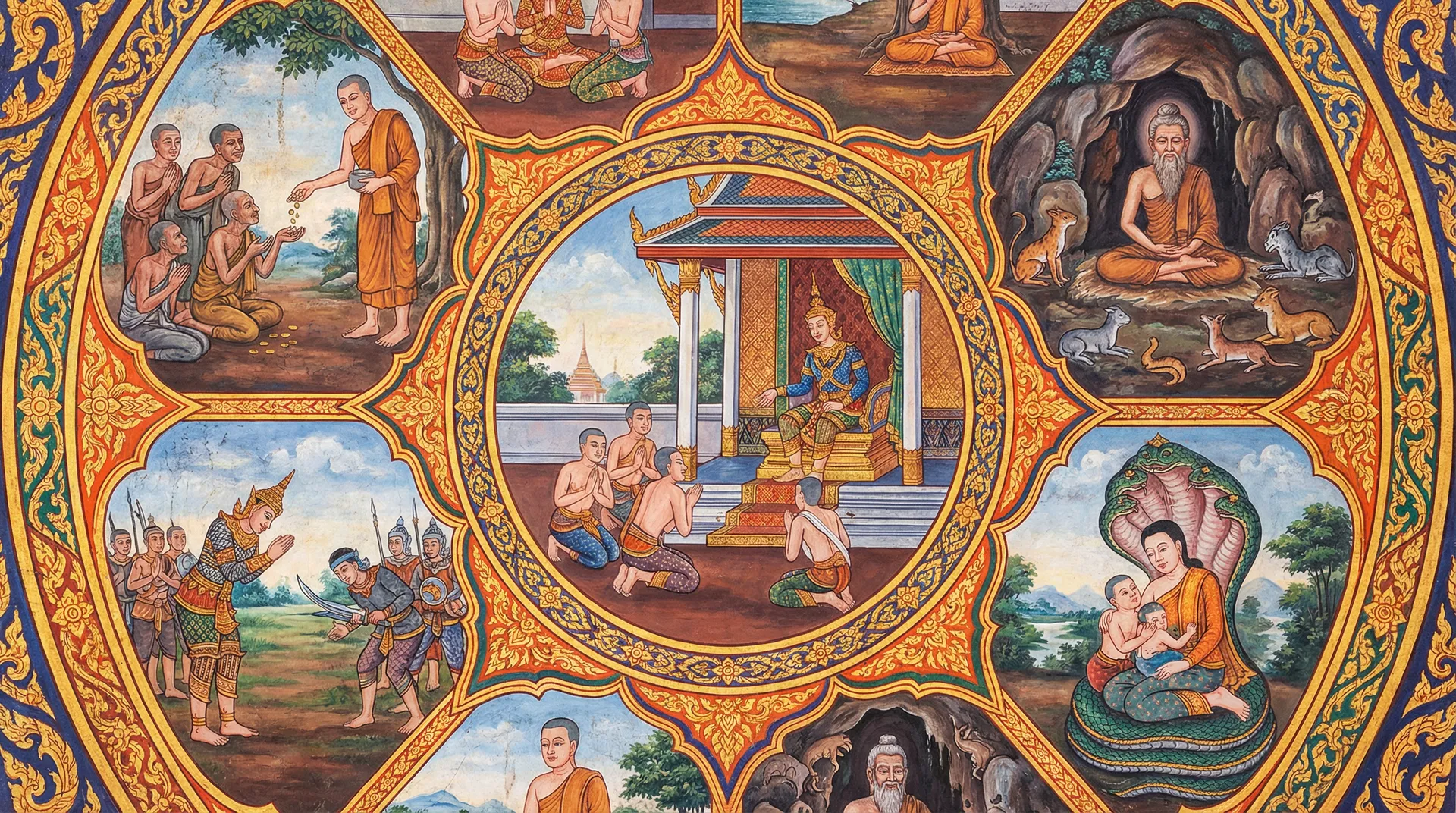
In the ancient and prosperous city of Varanasi, ruled a king named Brahmadatta. He was a just ruler, deeply devoted to the Dharma, and his kingdom was a beacon of peace and righteousness. His court was filled with learned scholars and wise ministers, each contributing to the smooth governance of the land.
One day, a delegation of foreign dignitaries arrived, their lands known for their vast riches but also for their internal strife and corruption. They had heard of the renown of King Brahmadatta’s kingdom and sought to learn the secret of its enduring peace and prosperity.
“O Illustrious King,” the chief envoy began, bowing low, “we have traveled far to witness the harmony that reigns in your kingdom. Our own lands are plagued by greed, envy, and discord. We seek your wisdom. What is the root of this unrest that plagues us, and how can we eradicate it?”
King Brahmadatta, with a thoughtful expression, stroked his beard. “Honored guests,” he replied, “the root of all unrest, the seed of all suffering, lies not in external circumstances, but within the human heart. It is the insatiable desire, the clinging attachment, the ignorance of the true nature of reality. This is the root of all evil.”
The dignitaries looked at each other, puzzled. Their understanding of evil was rooted in tangible things – thieves, murderers, corrupt officials. The idea of an internal, unseen root was foreign to them.
“But Your Majesty,” one of them interjected, “how can desire and attachment be evil? Are they not natural human inclinations? How can we live without wanting anything, or without caring for our possessions and loved ones?”
King Brahmadatta smiled gently. “The desire for sustenance, for shelter, for the well-being of loved ones – these are natural and necessary. But the craving that knows no bounds, the attachment that blinds us to truth, the greed that consumes our compassion – these are the destructive forces. They are like a creeping vine that chokes the life out of a noble tree.”
To illustrate his point, the King summoned his Royal Storyteller. “Tell us,” the King commanded, “the story of the Bodhisatta, who once lived as a wise ascetic in the Himalayas, and his encounter with the greedy merchant.”
The Storyteller cleared his throat and began:
“In a time long past, there lived a Bodhisatta, who had renounced the world and lived a life of profound meditation and austerity in a secluded mountain cave. His needs were few: simple roots and berries for sustenance, and the shelter of the cave. He had achieved great peace, detached from worldly possessions and desires.
“One day, a wealthy merchant, on his way to a distant market with a caravan laden with precious silks, gold, and jewels, lost his way in a fierce snowstorm. His camels perished, his goods were scattered, and he was left to wander, freezing and desperate. By sheer chance, he stumbled upon the Bodhisatta’s cave.
“The Bodhisatta, seeing the merchant’s plight, welcomed him with kindness. He shared his meager food and offered the warmth of his small fire. The merchant, though grateful for the immediate rescue, was distraught by the loss of his fortune. He lamented loudly, ‘All my wealth! My life’s work! Gone! Ruined!’
“The Bodhisatta listened patiently. When the storm subsided, he helped the merchant gather what little remained of his belongings. As they walked down the mountain, the merchant, still consumed by his loss, kept muttering about the value of the silks, the price of the jewels, the potential profits he had missed.
“The Bodhisatta, observing the merchant’s unwavering attachment to his lost wealth, decided to offer him a teaching. He led the merchant to a patch of fertile ground where a single, magnificent mango tree stood, heavy with ripe fruit. The tree was a sight to behold, its branches laden with sweet, juicy mangoes.
“‘Rest here, merchant,’ the Bodhisatta said. ‘Eat your fill.’
“The merchant, though still preoccupied, gratefully ate several mangoes. They were delicious, the best he had ever tasted. When he had finished, he wiped his mouth and prepared to leave.
“‘Wait,’ said the Bodhisatta. ‘Look at this tree. It has given you sweet fruit, quenched your hunger, and brought you pleasure. But does the tree itself crave your praise? Does it weep when you leave? Does it cling to you, begging you to stay?’
“The merchant looked at the tree, then at the Bodhisatta, bewildered. ‘Of course not,’ he replied. ‘It is a tree.’
“‘Precisely,’ said the Bodhisatta. ‘The tree performs its function, bears its fruit, and exists naturally, without craving or attachment. It does not suffer when you leave, nor does it boast when you praise it. Now, consider yourself. You have eaten the sweet mangoes, enjoyed their taste, and satisfied your hunger. Yet, you cling to the thought of the mangoes, you worry about their remaining, you lament their eventual decay. This clinging, this attachment, is the source of your suffering. It is a burden far heavier than any lost caravan.’”
“The merchant pondered the Bodhisatta’s words. He looked at the mango tree, then at his own troubled mind. He began to see how his attachment to wealth, his craving for more, was preventing him from experiencing the simple joy of the moment, the peace that the Bodhisatta radiated.
“‘The root of suffering,’ the Bodhisatta continued gently, ‘is this craving, this desire that binds us. It makes us chase after fleeting pleasures, hoard transient possessions, and lament their inevitable loss. It fuels anger when our desires are thwarted, and pride when they are fulfilled. If you wish to find peace, you must learn to appreciate what is, without clinging to what might be or what was.’”
The Storyteller concluded, “The merchant, deeply moved by this simple yet profound teaching, began to understand. He realized that his obsession with wealth had blinded him to the true treasures of life – kindness, peace, and contentment. He thanked the Bodhisatta and, though he could not recover his lost fortune, he returned to his city with a newfound clarity and a lighter heart, having learned to discern the true root of his suffering.”
King Brahmadatta turned back to the foreign dignitaries. “You see, honorable guests,” he said, “the greatest battle is not against external enemies or corrupt officials, but against the greed, hatred, and delusion within our own minds. Cultivate mindfulness, practice detachment, and understand the impermanent nature of all things. This is the path to eradicating the root of all evil, both within yourselves and in your kingdoms.”
The dignitaries, humbled and enlightened, thanked the king profusely. They returned to their lands, not with tangible solutions, but with the seed of wisdom, understanding that the true transformation of their kingdoms began with the transformation of their own hearts.
— In-Article Ad —
💡Moral of the Story
The root of all suffering and evil lies within the human mind, stemming from craving, attachment, and ignorance. True peace is found by understanding and overcoming these internal afflictions.
Perfection: Wisdom (Paññā)
— Ad Space (728x90) —
More Jataka Tales You May Enjoy
 359Pañcakanipāta
Mulaka Jataka
Mulaka Jataka In the bustling city of Savatthi, renowned for its vibrant markets and learned scholar...
💡 Integrity and honest hard work are virtues that ultimately bring true reward and respect, even when initially met with injustice. True perfection lies in dedication and honesty, not in pleasing the whims of the corrupt.
225DukanipātaMahapingala Jataka
Mahapingala JatakaIn the ancient and prosperous city of Kosala, where the river Sarayu flowed like a...
💡 True contentment comes from wanting less and appreciating what one has, rather than from the endless pursuit of more. Freedom from desire is the key to lasting happiness.
 50Ekanipāta
The Bodhisatta as the King of the Sarabha
The Bodhisatta as the King of the SarabhaIn the wild and untamed Himalayas, where snow-capped peaks ...
💡 True courage lies in selfless sacrifice for the protection of others, demonstrating profound compassion.
43EkanipātaThe Bodhisatta as the Clever Monkey
The Bodhisatta as the Clever MonkeyHigh in the canopy of a vast and ancient jungle, where sunlight s...
💡 Intelligence and unity are the most potent weapons against overwhelming adversity, and foresight can save lives.
58EkanipātaThe Great Ocean Jataka
In a land of bountiful shores, where the vast sea met fertile lands, there lay a small fishing villa...
💡 True wealth is found in generosity and compassion, not in material possessions. Greed blinds the mind and leads to self-destruction.
93EkanipātaAssaka Jataka
Assaka JatakaIn the ancient kingdom of Kasi, nestled beside the gentle flow of the River Ganges, sto...
💡 True generosity requires discernment. One must be careful not to be deceived by outward appearances or false piety, ensuring that one's charitable acts benefit those who are genuinely in need.
— Multiplex Ad —