
Mahosadha Jataka
The Tale of Mahosadha, the Wisest of All
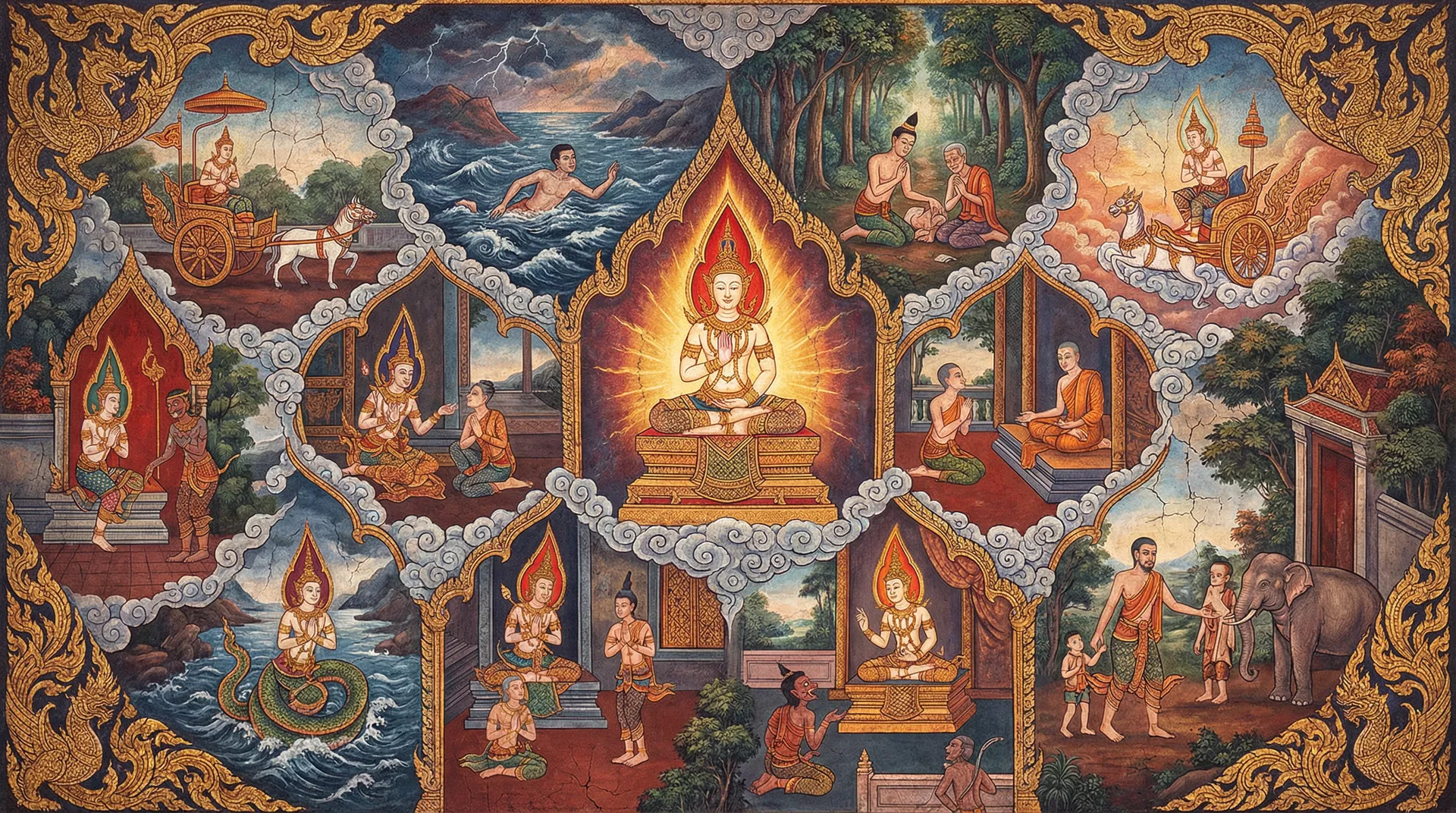
In the ancient city of Mithila, under the reign of King Vedeha, lived a boy destined to become the most renowned sage of his time: Mahosadha. From his very birth, it was evident that this child was no ordinary infant. His eyes seemed to hold an ancient wisdom, and even as a toddler, he displayed an uncanny ability to solve complex problems and offer insightful advice.
As Mahosadha grew, his reputation for unparalleled intelligence spread throughout the land. He possessed a mind that could unravel any mystery, a foresight that could predict future events, and a logic that could persuade even the most stubborn minds. King Vedeha, hearing of this remarkable youth, summoned him to his court.
The king, a man of great intellect himself, was immediately impressed by Mahosadha's profound wisdom. "Young man," the king declared, "you possess a brilliance that surpasses all others. I wish for you to be my chief advisor, my right hand, and the guardian of my kingdom's wisdom." Mahosadha, with humility and a deep sense of duty, accepted the king's offer.
Mahosadha's tenure as the king's advisor was marked by an era of unprecedented peace and prosperity for Mithila. He solved disputes with fairness and ingenuity, preventing wars and fostering harmony. One famous instance involved a dispute between two neighbouring kingdoms, each claiming ownership of a magnificent elephant. Both armies were on the brink of war, their anger fueled by pride.
Mahosadha, tasked with resolving the conflict, devised a clever plan. He asked both kings to send their strongest men to pull the elephant by its legs. The king whose men could pull the elephant forward was declared the true owner. When the test began, the elephant, sensing the tension, remained stubbornly still, refusing to budge for either side. Mahosadha then declared, "The elephant, sensing the discord and hostility, refuses to move. It is a creature of peace, and it will only move when there is harmony." He then suggested that both kings work together, with their men united, to gently lead the elephant. When they did, the elephant moved willingly, symbolizing the resolution of the conflict through unity.
Another time, a cunning merchant tried to cheat the king by presenting a counterfeit jewel. Mahosadha, with his sharp observation, noticed a slight imperfection. He then proposed a test: place the jewel in the palm of a sleeping man. If it was real, it would feel warm; if fake, it would feel cold. The counterfeit jewel, when placed on the sleeping merchant's hand, felt so cold that it woke him up in shock, revealing his deceit.
Mahosadha's wisdom was not limited to state affairs. He also guided the people of Mithila in their personal lives, teaching them the importance of ethical conduct, patience, and understanding. He would often use parables and riddles to impart his lessons, making them memorable and accessible to all.
The king relied heavily on Mahosadha's counsel, often saying, "Without Mahosadha, I am but a king without eyes." However, Mahosadha's growing influence and wisdom also attracted jealousy. Other courtiers, envious of his position, plotted against him. They spread rumors and tried to frame him for treason, but Mahosadha's integrity and foresight always saved him.
One of the most challenging situations Mahosadha faced was when King Vedeha fell gravely ill. The royal physicians were baffled, and the kingdom plunged into despair. Mahosadha, through his deep understanding of natural laws and subtle energies, discovered that the king was suffering from a rare ailment caused by an imbalance of humors. He prepared a special herbal remedy, administered with precise timing and intention, which gradually restored the king's health.
Mahosadha's life was a testament to the power of knowledge, reason, and compassion. He demonstrated that true wisdom is not just about intellect, but about applying that intellect for the benefit of all beings. He showed that with foresight and a clear mind, even the most complex problems can be solved, and a society can flourish in peace and harmony.
Even after King Vedeha's passing, Mahosadha continued to serve the succeeding kings, always upholding the principles of justice, truth, and universal well-being. His teachings and his legendary deeds inspired countless individuals, solidifying his place as one of the greatest wise men in history. The city of Mithila, guided by his wisdom, became a beacon of civilization and enlightenment, a living legacy of Mahosadha's extraordinary mind and compassionate heart.
— In-Article Ad —
💡Moral of the Story
Profound wisdom, applied with compassion and foresight, can bring peace, prosperity, and justice to a kingdom and its people.
Perfection: Wisdom (Prajna)
— Ad Space (728x90) —
More Jataka Tales You May Enjoy
46EkanipātaThe Bodhisatta as the Weaver Bird
The Bodhisatta as the Weaver BirdIn the lush green canopy of a sprawling banyan tree, where sunlight...
💡 Diligence, honesty, and compassion are the foundations of true security and a virtuous life.
 314Catukkanipāta
Vessantara Jataka
Vessantara JatakaIn the prosperous kingdom of Siwi, nestled beside the gently flowing Anjana River, ...
💡 The perfection of generosity involves the willingness to give even one's most cherished possessions, including one's own children and spouse, for the sake of others, leading to immense merit and spiritual growth.
 214Dukanipāta
Samukkita Jataka
The Value of Truthful SpeechIn the ancient city of Ujjain, there lived a renowned scholar named Vidh...
💡 Truthful and honest communication is the most effective means of resolving conflict and building lasting peace and prosperity, far more valuable than deception or force.
108EkanipātaKacchapa Jataka
The Tale of the Wise Tortoise and the Foolish Fishermen In a lush, verdant forest, far from the clam...
💡 Respect the natural world and its resources. Greed that depletes without thought for replenishment leads to ruin and loss.
150EkanipātaMahapada Jataka
Mahapada JatakaIn the ancient and prosperous city of Varanasi, there reigned a king named Bodhisatta...
💡 The greatest gift a ruler can give to their people is the teaching of righteousness and virtue (Dhamma), which leads to inner peace, wisdom, and lasting happiness.
 547Mahānipāta
Mahāsutasoma Jātaka
The Tale of the Great Sutasoma In the city of Indapatta, ruled a wise and just king named Pāṭaliputt...
💡 The unwavering commitment to truth, even in the face of death, possesses a transformative power that can overcome the deepest darkness and bring about profound change.
— Multiplex Ad —