
Sankhapala Jataka
Sankhapala Jataka
In the ancient and prosperous city of Savatthi, there once lived a king named Supparaka, a ruler whose heart was as vast as the ocean and as steadfast as the Himalayas. He was beloved by his people, for his reign was a beacon of justice, compassion, and unwavering truth. However, even the most virtuous rulers face trials that test the very core of their being.
One day, the King, while practicing deep meditation, attained a profound insight into the workings of karma. He understood that his current reign of peace and prosperity was a direct result of his past virtuous deeds, and he also perceived a future consequence of a specific, yet seemingly minor, transgression from a previous life. This transgression involved a moment of anger and harshness towards a gentle creature.
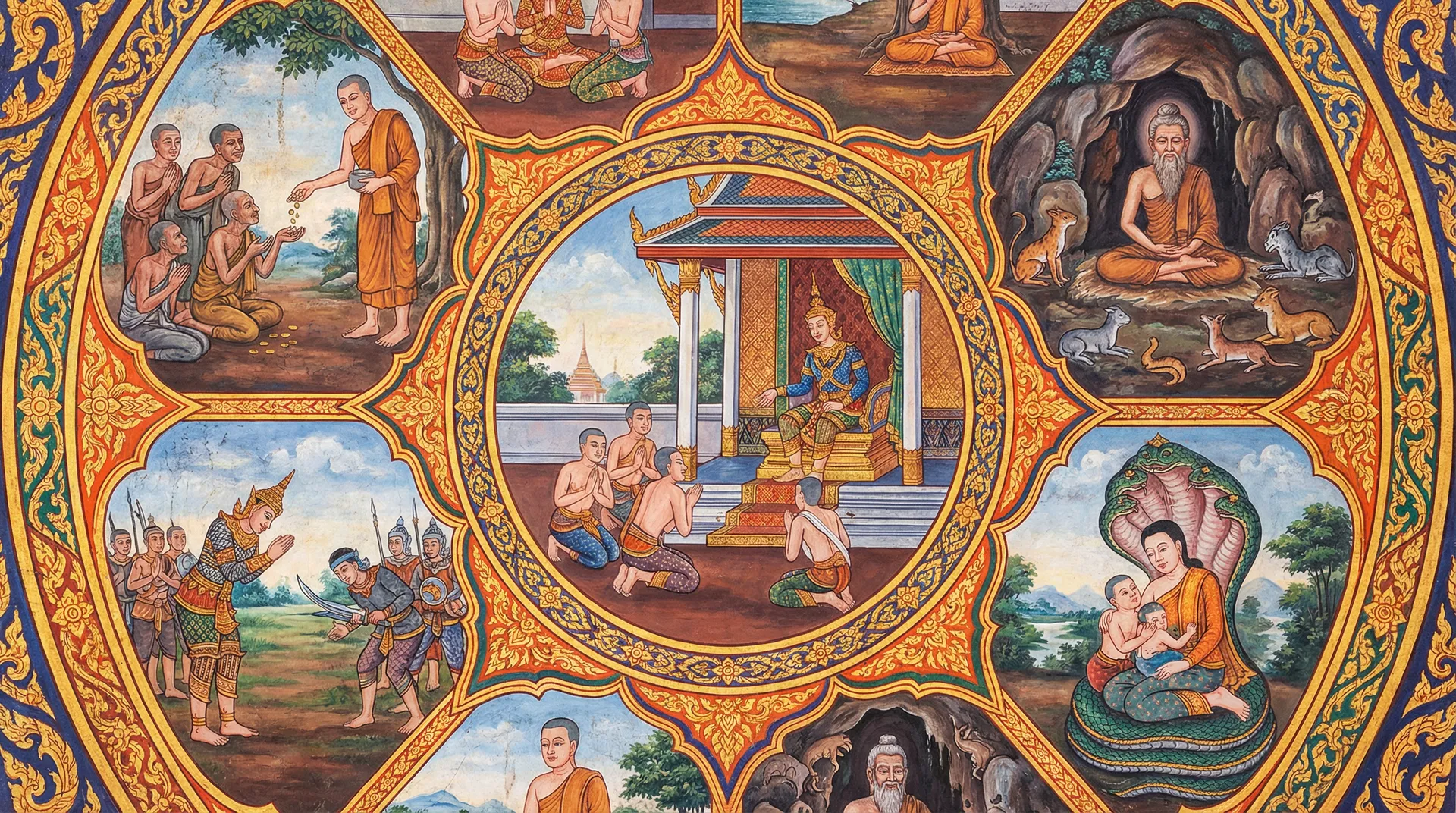
The vision revealed that in a past existence, as a Bodhisattva, he had been born as a mighty serpent king named Sankhapala. He resided in a magnificent underwater palace, surrounded by his queen and his retinue. Sankhapala was a serpent of immense power and wisdom, dedicated to upholding Dharma and protecting his realm. His queen, a serpent of equal virtue and beauty, was his devoted companion.
One day, while Sankhapala was basking in the sun near the banks of a river, a group of ascetics, who had gathered for a spiritual discourse, were disturbed by the presence of a venomous snake. Fearful, they cried out and begged the Bodhisattva, who was then a human king, to remove the threat. King Supparaka, though he possessed great compassion, was momentarily overcome by a surge of pride and a desire to display his power. He struck the serpent with his staff, not to kill, but to drive it away. The serpent, though unharmed, was deeply wounded by the king's harshness and the disregard for its own existence.
In his vision, Sankhapala, the serpent king, felt the sting of that blow and the king's impatience. He understood that this act, though not intended to cause mortal harm, had created a karmic debt. The vision showed that in his current life as King Supparaka, this debt would manifest as a severe illness, specifically a painful swelling that would afflict his body, causing him immense suffering.
The vision was clear: the illness would be incurable by conventional means and would only be alleviated by the very ascetic he had wronged in his past life. Sankhapala, the serpent king, though saddened by the king's action, possessed immense compassion. He knew that his own future well-being was tied to rectifying this karmic imbalance.
Upon waking from his meditation, King Supparaka felt the first pangs of the predicted illness. A painful swelling began to appear on his body, growing with alarming speed and causing him excruciating agony. His court physicians, renowned for their skills, were baffled. They tried every remedy known to them, but nothing could alleviate his suffering. The king grew weaker each day, his once vibrant spirit dimmed by pain.
Remembering the vision, King Supparaka understood that his suffering was a karmic consequence. He knew he had to find the ascetic he had wronged. He dispatched messengers throughout the land, seeking any wise hermit or ascetic who might have knowledge of ancient healing arts or a connection to the spiritual realm.
His messengers searched far and wide. Finally, they heard tales of a solitary ascetic, living a life of extreme penance in a remote cave, who possessed extraordinary wisdom. This ascetic, it was said, had once been a serpent king who had suffered a grievous wrong.
The messengers found the ascetic. He was indeed Sankhapala, the serpent king from the Bodhisattva's past life, now living as a humble hermit. Sankhapala, through his deep spiritual practice, had transcended the anger and resentment he once felt. He recognized the king's suffering as a karmic manifestation and saw this as an opportunity for both of them to find peace.
The messengers explained the king's plight. Sankhapala, without hesitation, agreed to help. He traveled with the king's messengers back to Savatthi. When he arrived at the palace, the king, weak and in pain, prostrated himself before the ascetic. 'Wise one,' he pleaded, 'I have brought this suffering upon myself through my past actions. I beg for your forgiveness and your aid.'
Sankhapala, with a serene smile, approached the king. He did not condemn or chastise. Instead, he gently touched the king's swollen body and began to chant ancient mantras, his voice resonating with compassion and spiritual power. As he chanted, the swelling began to recede, and the king's pain eased. The healing was not instantaneous, but gradual, a testament to the power of forgiveness and spiritual merit.
Over the following days, Sankhapala remained with the king, continuing his healing chants and imparting profound spiritual teachings on the nature of karma, compassion, and the interconnectedness of all beings. King Supparaka listened with rapt attention, his heart filled with gratitude and remorse. He understood the depth of Sankhapala's forgiveness and the power of his spiritual discipline.
As the king's health returned, so did his understanding. He vowed to live the rest of his life with even greater compassion and non-violence, ensuring that no creature would ever suffer from his actions again. Sankhapala, having fulfilled his karmic duty and having witnessed the king's sincere repentance, returned to his hermitage, leaving behind a kingdom healed and a king transformed.
— In-Article Ad —
💡Moral of the Story
Our actions, even those seemingly minor, have far-reaching consequences. Forgiveness, compassion, and spiritual discipline are powerful forces that can heal suffering and mend karmic imbalances.
Perfection: Generosity (Dana Paramita)
— Ad Space (728x90) —
More Jataka Tales You May Enjoy
 365Pañcakanipāta
Sādhina Jātaka
Sādhina JātakaIn the ancient land of Kasi, there was a prosperous city ruled by a wise and just king...
💡 True prosperity and the integrity of a kingdom depend on the unwavering commitment to righteousness and honesty in all dealings, especially in matters of wealth. Selfless dedication to truth and virtue can overcome corruption and restore purity.
127EkanipātaSasa Jataka
Sasa JatakaLong ago, in a time when the world was young and the stars seemed closer to the earth, th...
💡 The highest form of generosity is to give without reservation, even one's own life, motivated purely by compassion for others.
 255Tikanipāta
Sattigumba-Jātaka
Sattigumba-JātakaIn the sprawling kingdom of Kasi, renowned for its skilled artisans and vibrant mar...
💡 True magnificence and strength lie in compassion, respect for nature, and harmonious coexistence, not in dominance or possession. Righteous rule is demonstrated through justice, empathy, and the protection of all living beings.
64EkanipātaThe Bodhisatta's Compassion in Times of Famine
The Bodhisatta's Compassion in Times of Famine In the ancient kingdom of Benares, a time of unprece...
💡 Keeping one's promises is extremely important. Breaking a vow will lead to bad karma.
66EkanipātaThe Great Crane Jataka
Long ago, in an age when the Buddha had not yet appeared, in a time immeasurably distant, the Bodhis...
💡 True wealth is measured not by the abundance of possessions, but by the happiness and prosperity of one's people. Greed leads to suffering, while generosity and compassion bring true prosperity.
71EkanipātaThe Jataka of the Clenched Fist
In a time long past, in the prosperous city of Varanasi, the Bodhisatta was born as a young Brahmin ...
💡 True leadership lies in protecting the vulnerable, even at great personal risk.
— Multiplex Ad —